





by Dr. Ma’asehyahu Isra-Ul
This article provides a brief historical overview of Judaism in Africa with an emphasis on specific communities throughout the Continent.
Introduction
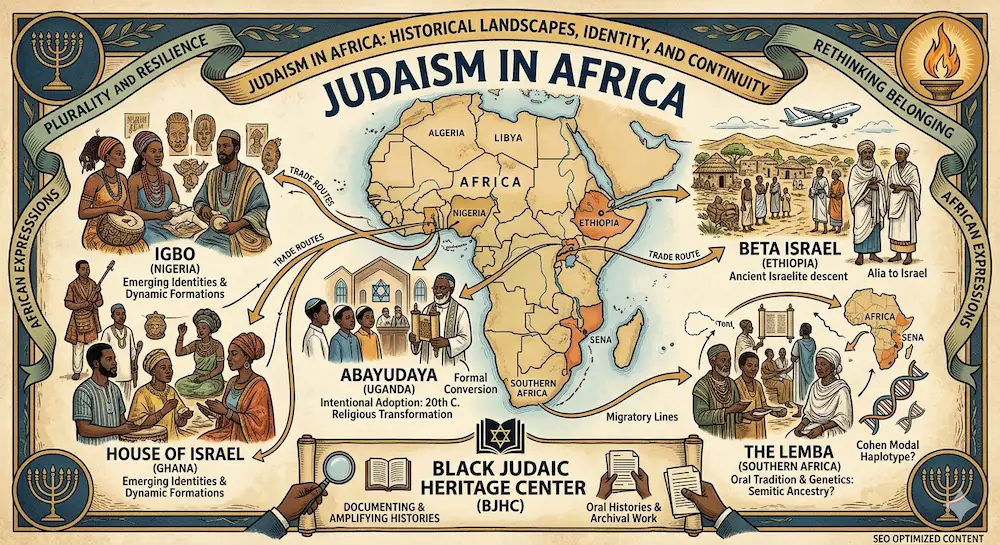
Judaism’s historical presence in Africa spans a remarkable range of geographies, practices, and identities. From ancient indigenous communities to modern movements of embraced Jewish life, African Jewish histories challenge conventional narratives that link Judaism exclusively to Europe and the Middle East. This article provides an accessible yet scholarly overview of major Jewish communities in Africa, foregrounding the Beta Israel (Ethiopia), the Lemba (Southern Africa), the Abayudaya (Uganda), and emerging Jewish identities such as the Igbo (Nigeria) and Akan-Sefwi (Ghanaian descendants of “Old Mali” Jews). It also highlights contemporary documentation and advocacy work, including research and preservation efforts by the Black Judaic Heritage Center.
Beta Israel of Ethiopia: Indigenous Jewish History
Beta Israel, literally “House of Israel,” represents one of the oldest continuous Jewish communities in Africa. Known historically by the name “Falasha” (now regarded as pejorative), the Beta Israel lived predominantly in northern Ethiopia and claimed ancient Israelite descent, including traditions linking them to the Tribe of Dan, one of the biblical Ten Lost Tribes.¹ In medieval rabbinic literature, travelers such as Eldad Ha-Dani referred to Jewish populations in East Africa, and later Jewish legal authorities affirmed the Beta Israel as Jewish in halakhic (Jewish legal) terms. In the 20th century, Sephardic Chief Rabbi Ovadia Yosef and other Israeli authorities ratified their Jewish status and advocated for their immigration to Israel under the Law of Return.²
Over decades of political turmoil and famine, tens of thousands of Beta Israel were evacuated to Israel in airlift operations such as Operation Moses (1984–1985) and Operation Solomon (1991).³ Today, the Ethiopian Jewish community in Israel is a deeply rooted and vibrant part of broader Jewish life, maintaining religious traditions shaped by centuries of independent development while engaging with global Judaism.
The Lemba: Oral Tradition, Genetics, and Jewish Identity
The Lemba are a Bantu-speaking people of southern Africa, primarily in South Africa, Zimbabwe, and neighboring countries, whose oral traditions describe descent from ancient Semitic (specifically Sephardic) ancestors and a migration from a place called Sena.⁴ Though many Lemba today are Christian, and some Muslim, their cultural memory includes practices resembling Judaic norms such as ritual male circumcision, dietary taboos, and endogamy.⁵
Genetic studies have shown that a significant portion of Lemba Y-chromosomes cluster with Semitic lineages, in contrast to surrounding Bantu populations, lending partial scientific support to their oral history.⁶ Notably, some members were believed to carry a version of the Cohen Modal Haplotype, a Y-chromosome pattern linked to traditional Jewish priestly lines (though recently under reinvestigation).⁷ While genetic affinities alone are not determinative of religious belonging under most Jewish halakhic authorities, these findings have helped fuel scholarly discussion about the constructions of identity and Jewish indigeneity in Africa.⁸
Abayudaya of Uganda: Intentional Jewish Adoption
The Abayudaya (“People of Judah”) community in eastern Uganda represents an important case of Jewish adoption and self-identification rooted in an early 20th-century religious transformation. In 1919, Semei Kakungulu, a prominent Ugandan leader, embraced the Hebrew Bible and guided his followers toward Jewish observance. While the Abayudaya’s origin does not stem from from ancient Israelite communities, they have maintained Jewish practices which include Sabbath observance, ritual circumcision, and Torah study for over a century.⁹ (Several Abayudaya communities have embraced normative (“Rabbinic”) Judaism fully and live as any other reasonably observant Jews around the world.)
After years of marginalization and suppression under political regimes including Idi Amin’s, the community rebuilt its religious life in the late 20th and early 21st centuries. Many members have undergone formal conversion or affirmation through Conservative and Reform Jewish authorities, and figures such as Rabbi Gershom Sizomu have emerged as recognized leaders, bridging local tradition with broader Jewish engagement.¹⁰
Emerging Communities and African Jewish Landscapes
Beyond these well-documented groups, a variety of African communities assert Jewish identity in diverse forms. The Igbo Jews of Nigeria are among the most discussed West African groups, with thousands claiming Jewish ancestry or adopting Jewish identity and practice, often supported by organizations engaged with Jewish diaspora initiatives.¹¹ Similarly, the House of Israel in Ghana (a small community in the heights beyond Kumasi claiming Israelite descent) highlights the complex interplay of oral history, cultural self-identification, and modern Jewish engagement.¹²
Scholarly works surveying Jewish life across the continent list numerous communities, from the Beth Yeshourun groups in Cameroon to the Baluba Jews in Congo and the Descendants of David in Madagascar (“the Malagasy Secret”), reflecting both historic claims and contemporary formations of Jewish identity.13 While recognition by mainstream Jewish denominations varies widely, these groups embody the ongoing dynamism of Jewish life in Africa.14
Contemporary Scholarship and the Black Judaic Heritage Center
Understanding Judaism in Africa requires moving beyond singular paradigms of ethnicity, theology, or genetics. The Black Judaic Heritage Center (BJHC) plays a pivotal role in documenting and amplifying the histories of Black Jewish communities, ensuring that their voices are present in broader Jewish scholarship and cultural heritage initiatives. Through archival work, oral history projects, and community collaboration, BJHC contributes to a richer and more inclusive narrative of global Judaism.
Conclusion
African Jewish histories, from indigenous traditions to chosen religious identity, demonstrate the plurality and resilience of Jewish life on the African continent. These communities challenge the field to rethink definitions of Jewish belonging, illuminate the intersections of culture and religion, and affirm the ongoing relevance of African expressions of Judaism today.
Sources
Shalva Weil, “Ethiopian Jews,” in Encyclopedia of the Jewish Diaspora: Origins, Experiences, and Culture, ed. M. Avrum Ehrlich (Santa Barbara, CA: ABC-CLIO, 2009).
Encyclopedia Britannica, “Beta Israel,” updated November 24, 2025, https://www.britannica.com/topic/Beta-Israel.
StandWithUs, The Jewish People: A Beautiful Mosaic (2024), 14–15.
L. A. Andreeva, “Black Jews of South Africa: The Lemba People,” Asia and Africa Today 2025, 57–63.
NOVA, “The Lemba, the Black Jews of Southern Africa,” PBS, 2000, https://www.pbs.org/wgbh/nova/israel/familylemba.html.
A. B. Spurdle and T. Jenkins, “The origins of the Lemba ‘Black Jews’ of southern Africa,” Am. J. Hum. Genet. 59, no. 5 (1996): 1126–1133.
Ibid.
Tudor Parfitt and Y. Egorova, “Genetics, history, and identity: the case of the Bene Israel and the Lemba,” Culture, Medicine, and Psychiatry 29.
Jewish Virtual Library, “A History of the Abayudaya Jews of Uganda,” accessed January 2026, https://www.jewishvirtuallibrary.org/a-history-of-the-abayudaya-jews-of-uganda.
University of Maryland, Department of African American and Africana Studies. “Unsung Hero: Rabbi Gershom Sizomu.” Accessed January 8, 2026. https://aaas.umd.edu/undergraduate/unsung-hero-rabbi-gershom-sizomu
D. Kohnert, On the history of Jews in Sub-Saharan Africa (MPRA Paper No. 120512, 2024).
Edith Bruder, “The House of Israel in Ghana,” in New Jews: The End of the Jewish Diaspora?, ed. Tudor Parfitt and Emanuela Trevisan Semi (London: Tauris Academic Studies, 2002).
Edith Bruder, Jews from Elsewhere: Forgotten Diasporas and Singular Jewish Identities (Oxford Academic, 2026).
Kulanu. “Ghana.” Accessed January 8, 2026. https://kulanu.org/ghana
*This piece benefited from AI-assisted editing. All ideas, analysis and conclusions are the author’s own.