
The history of Sephardic Jews spans Iberia, the 1492 expulsion, and migrations that shaped global Jewish culture.
The history of Sephardic Jews is a rich narrative of resilience, creativity, and cultural brilliance. Rooted in the ancient Jewish communities of the Iberian Peninsula, Sephardic Jewish history rose to prominence during medieval Spain’s golden age, only to be scattered by the traumatic expulsion of 1492. Their subsequent migrations completely reshaped Jewish life from North Africa to the Ottoman Empire, and their distinct customs continue to mold global Jewish culture today. To understand who these vibrant communities are in the modern world, see our Who Are Sephardic Jews page for a detailed overview of their contemporary origins, culture, and worldwide presence.
In modern usage, the term Sephardic often includes Mizrahi Jews—those from the Middle East and North Africa—because the Sephardic religious rite became dominant across these regions after the expulsions. While Mizrahi Jews are historically distinct, their heritages frequently intertwine, and many global institutions group them together under the umbrella of “Sephardic.”
Though the defining chapter of Sephardic Jews history begins in medieval Spain, the story has much deeper, complex origins.
Early Iberian Presence: Archaeological and textual evidence points to active Jewish life in Spain and Portugal as early as the Roman period, and possibly even earlier through ancient Phoenician trade routes.
North Africa and the Berbers: Vibrant Jewish communities thrived in Morocco, Algeria, and Tunisia long before the arrival of Islam. They lived alongside Amazigh (Berber) tribes, sharing languages and local customs while fiercely maintaining Jewish law and tradition.
Babylonia and Beyond: Many families who later merged into the Sephardic and Mizrahi traditions trace their primary ancestry directly to Babylonia, where the Talmud was compiled, as well as to centuries-old Jewish enclaves in Persia, Yemen, and Egypt.
These early layers remind us that Sephardic history is not only a story of exile, but also one of deep cultural continuity across diverse lands.
Between the 8th and 12th centuries, under Muslim al-Andalus, Jewish culture flourished in Spain. Protected as dhimmis, Jews were limited in rights but participated in intellectual and economic life. This era produced some of Judaism’s greatest minds:
Judah Halevi (poet and philosopher)
Solomon Ibn Gabirol (philosopher and poet)
Maimonides (rabbi, philosopher, and physician, born in Córdoba)
Jewish scholars actively translated Greek and Arabic works into Hebrew and Latin, serving as vital cultural bridges for all of Europe. High commerce, advanced medicine, and state governance were open to Jews in ways rarely seen elsewhere in the medieval world.
However, as Christian kingdoms aggressively advanced southward during the centuries-long Reconquista, conditions deteriorated. Pockets of massacres, forced conversions, and highly restrictive laws heavily foreshadowed the catastrophe of 1492.
Interested in how these migrations shaped your family’s traditions? See our Sephardic Timeline.
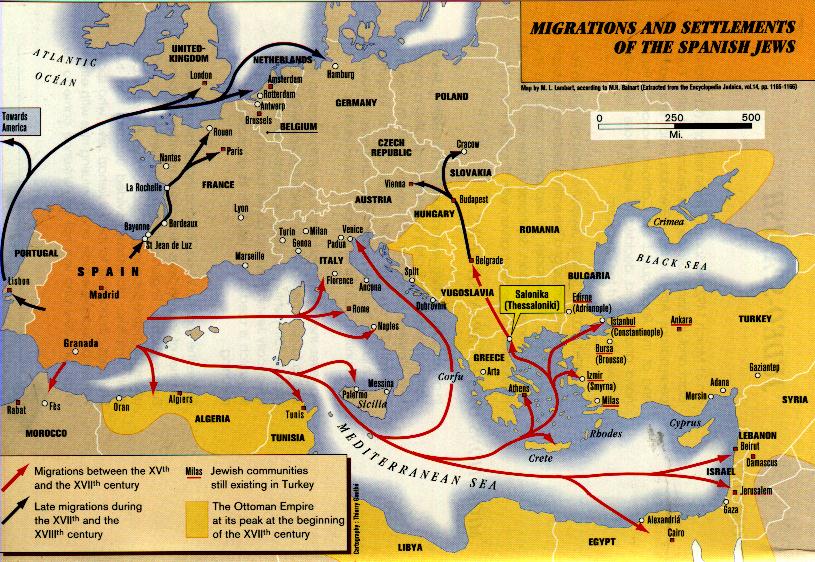
| Destination | Impact on Sephardic History |
|---|---|
| Ottoman Empire | Warmly welcomed by Sultan Bayezid II; massive communities thrived in Salonika, Istanbul, Izmir, Sarajevo, and Safed. |
| North Africa | Morocco, Algeria, and Tunisia absorbed waves of refugees, beautifully merging them with older, native Jewish populations. |
| Italy | Cities like Venice, Livorno, and Ferrara became elite Sephardic merchant, trade, and printing hubs. |
| Netherlands | Amsterdam hosted a highly prosperous, open community renowned for international finance, philosophy, and printing. |
| Balkans | Historic new centers emerged and flourished in Bosnia, Bulgaria, and Macedonia. |
| New World | Conversos and eventually openly practicing Jews reached Brazil, the Caribbean, Mexico, and ultimately North America. |
This diaspora spread Sephardic culture far beyond Iberia, creating a global network of Jewish life that persists today.
For those who remained in Iberia under duress, life became a dangerous underground struggle. The Spanish Inquisition brutally hunted down Conversos (New Christians) suspected of secretly practicing Judaism, known historically as Crypto-Jews or Anusim. This climate of persecution sparked centuries of secret traditions, forcing many to flee generations later to reclaim their heritage openly in places like Amsterdam or the Americas.
In strict historical terms, Sephardic Jews descend directly from those expelled from Iberia. Yet over time, the term has taken on a much broader, integrated meaning:
Liturgical Influence: The highly structured Sephardic prayer rites spread widely, eventually being adopted wholesale by Mizrahi communities from Iraq to Yemen.
Cultural Overlap: Refugees settling in Middle Eastern lands intermarried deeply with local, native Jews, permanently blending their traditions.
Modern Usage: In Israel and western institutions, “Sephardic” often refers to anyone who is not Ashkenazi, including Mizrahi Jews.
This broader usage sometimes blurs distinctions, but it highlights a shared history of migration, adaptation, and survival. For a clear introduction to Sephardic identity, beliefs, and traditions, visit Who Are Sephardic Jews.
Among all North African lands, Morocco stands out prominently in Sephardic Jewish history.
Ancient Presence: Jewish life in Morocco predates Islam by centuries, with deep traditions tracing ancestry back to the Babylonian exile.
Berber Connection: Many Jews lived directly among Amazigh tribes, maintaining Hebrew liturgy while absorbing local languages.
Medieval Flourishing: Fez, Meknes, and Marrakech hosted vibrant Jewish quarters (Mellahs), which became global centers of trade and learning.
Sephardic Influx: After 1492, Spanish exiles merged fully with native Moroccan Jews, enriching the local culture with new customs, distinct surnames, and vast commercial networks.
By the early 20th century, Morocco’s Jewish population exceeded 250,000, making it the largest in the Muslim world. Today only a few thousand remain in the country, but Moroccan Jewish culture—its music, food, and liturgy—continues to heavily influence global Sephardic life.
The 19th and early 20th centuries brought European colonial powers into North Africa and the Middle East. Schools established by the Alliance Israélite Universelle introduced European languages and western secular education, fundamentally transforming the cultural landscape of Sephardic and Mizrahi communities.
The tragic events of the Holocaust deeply scarred Sephardic communities. In Greece and the Balkans, historic Sephardic hubs in Salonika, Rhodes, and surrounding areas were nearly completely annihilated by Nazi forces. In North Africa, Jews living under Vichy French rule endured forced labor camps, property confiscations, and severe legal persecution. Learn more details about this era in our specialized guide on Sephardim in the Holocaust.
The creation of the State of Israel in 1948 triggered a massive, irreversible demographic shift. Rising nationalism and severe anti-Jewish hostility across the Arab world forced nearly 850,000 Jews—Sephardic and Mizrahi alike—to flee their ancestral homes between 1948 and the 1970s. Most resettled in Israel, France, or the Americas, leaving behind ancient communities that had thrived for millennia.

Language and culture played a vital role in preserving Sephardic identity across centuries of dispersion.
Ladino (Judeo-Spanish): Preserved medieval Spanish enriched with Hebrew, Turkish, and Arabic elements. Once spoken widely from Morocco to the Balkans, it is now critically endangered.
Judeo-Arabic: Common across North Africa and the Middle East, this language carried legendary Jewish philosophy, biblical commentary, and poetry.
Modern Sephardic Ancestry and DNA Discovery: In recent years, genetic science has allowed descendants of hidden lineages worldwide to uncover their historical roots. You can map out these timelines using our interactive Sephardic Timeline.
Sephardic culture thrives through music, art, and creative expression. Traditional melodies, visual arts, and storytelling have been preserved across generations, providing a window into the values, celebrations, and daily lives of Sephardic communities. Music is at the heart of Sephardic heritage, carrying prayers, stories, and celebrations across generations.
Explore: Listen to Sephardic Music →
The flavors of Sephardic cuisine tell the story of history, migration, and tradition. Sephardic foods—couscous, borekas, tagines—and musical traditions with Middle Eastern instruments reflect centuries of cultural blending. Explore recipes, culinary customs, and symbolic foods that bring communities together for celebrations and daily life. Sephardic foods—couscous, borekas, tagines—and musical traditions with Middle Eastern instruments reflect centuries of cultural blending. Explore recipes, culinary customs, and symbolic foods that bring communities together for celebrations and daily life. For a deep dive into the heritage and laws behind our most sacred observance, see our Complete Sephardic Passover Guide.
Explore: Taste Sephardic Cuisine →
Influential Sephardic figures have left a lasting impact on religion, philosophy, art, and global culture. From scholars like Maimonides to leaders in civic and cultural spheres, these individuals reflect the enduring contributions of Sephardic Jews.
Explore: Discover Notable Sephardim →
Tracing your ancestry is a meaningful way to connect with Sephardic heritage. Use our genealogical resources to uncover your family story, connect with distant relatives, and preserve your lineage for future generations.
Explore: Start Your Journey →
By the mid-20th century, centuries-old Jewish communities in Morocco, Iraq, Egypt, and elsewhere dwindled. Today, only small numbers remain in many ancestral homelands. Synagogues are preserved as cultural heritage, and oral histories are being recorded to protect memory.
At the same time, Sephardic Jews have thrived in Israel, France, the United States, Canada, and Latin America, ensuring their traditions live on in new contexts.
The history of Sephardic Jews is one of survival and renewal. From ancient roots in Iberia and North Africa, through the golden age of Spain, the trauma of expulsion, and the challenges of migration, Sephardic Jews have carried forward a legacy of scholarship, liturgy, and culture.
Their story is not only about exile—it is about resilience, adaptation, and the enduring strength of Jewish identity. As Sephardic traditions continue to shape global Judaism, the history of Sephardic Jews remains a living legacy, bridging the past with the future. Learn more about the people behind this history on our Who Are Sephardic Jews page.
For detailed insights into Sephardic population trends, migration destinations, and historical demographics, see our Sephardic Population Statistics & Trends page.
For a comprehensive collection of Sephardic guides, practical tools, and materials, our Resources Hub offers everything you need to explore Jewish life, heritage, and community.
Explore: Go to Resources Hub →
Discover timelines, influential rabbis, and key statistics that bring Sephardic Jewish history to life.
Historically, Sephardic Jews trace their heritage to the Iberian Peninsula (Spain and Portugal) prior to the 1492 expulsion. Mizrahi Jews descend from ancient communities in the Middle East, North Africa, and Central Asia that never lived in Iberia. However, because Mizrahi communities widely adopted the Sephardic liturgical rite and religious laws after the 15th century, the two terms are frequently grouped together under the umbrella of “Sephardic” in modern usage and within Israel.
The primary vernacular of the Sephardic diaspora is Ladino (also known as Judeo-Spanish), which is based on Old Castilian Spanish mixed with Hebrew, Aramaic, Turkish, and Arabic. In communities throughout North Africa and the Middle East, Sephardic and Mizrahi scholars and citizens also extensively used Judeo-Arabic for literature, business, and philosophy.
Following the Alhambra Decree, refugees fled across the globe. Major settlements were established in the Ottoman Empire (including modern-day Turkey, Greece, and the Balkans), North Africa (Morocco, Algeria, Tunisia), Italy, and the Netherlands. Eventually, many families migrated to the New World, settling in the Caribbean, South America, and North America.