God's Covenant with Abraham
God appeared to Abraham with a promise of offspring and their subsequent inheritance of the Land of Israel - between the river of Egypt and the Euphrates.
The Division of the Kingdom; Israel & Judah
King Solomon's death led to the division of the kingdom into two: Judah and Israel (also named Samaria). The division led to political and spiritual deterioration. Wars and assimilation became common.
Exile of the 10 Tribes by Assyria
Around two hundred years after the division of the kingdom, the Assyrian Empire conquered the kingdom of Israel. The remaining population of the ten tribes of Israel either fled to Judah or were exiled to Assyria.
Destruction of the 1st Temple by Babylon
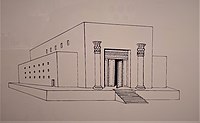
Babylonian conquest brings terrible devastation, destruction and exile. Those who remain are poor and incompetent. The day the Temple was burned, Tisha B'Av, was set to be a fast day.
Assassination of Gedalia and the Babylonian destructive response
Assassination of Gedalia, governor of Palestine. The Babylonian response was destructive. A fast day was set to commemorate the terrible event and its consequences.
Return to Zion following Cyrus's decree
Cyrus of Persia allows Jews to return to Eretz Yisrael. About 50,000 return led by Zerubbabel. Ezra and Nehemiah lead other Alyia waves and spiritual revival.
Purim – the Jews are saved from a planned massacre
The event, told in the Book of Esther, is the source of Fast of Esther Day and Purim, celebrated since then on the fourteenth of Adar (and Shushan Purim on the 15th of Adar).
Re-dedication of the Temple thanks to the Maccabean Revolt
Maccabbean Revolt rose against the Greek Empire, as its king Antiochus outlawed Jewish traditions and ordered a pagan altar to be set up in the Temple at Jerusalem. The revolt succeeded and the temple was dedicated. Hanukkah, celebrated during eight days from the twenty-fifth day of Kislew (December), chiefly as a festival of lights, was instituted by Judas Maccabeus, to be celebrated annually with mirth and joy as a memorial of the dedication of the altar.
Destruction of the 2nd Temple by Rome
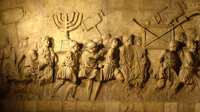
Roman army led by Titus to suppress the Jewish Big Revolt did so brutally. The suffering in Jerusalem was terrible. According to Josephus, even before the siege was ended, 600,000 bodies had been thrown out of the gates. On the 17th of Tamuz the Romans entered Jerusalem. On the 9th of Av they destroyed the Temple. Both days were set to be fast days ever since. Many of the inhabitants were killed or carried off and sold as slaves in the Roman markets.
Bar Kokhva rebellion suppressed
Roman anti-Jewish laws lead to the Bar-Kokhva Revolt. Although successful at first, the revolt was firmly suppressed after three years. As many as 580,000 Jews fell in battle, not including those who succumbed to hunger and pestilence. It was then when the Romans gave the name “Palestine” to the land of Israel so that the Jewish connection to the land would vanish. For the same reason Jews were not allowed into Jerusalem and Jewish traditions were outlawed.
Dome of the Rock built on the Temple's ruins
Caliph Abd al-Malik completes the construction of the shrine “Dome of the Rock” on the Jewish Temple's ruins in Jerusalem.
Khazar converts to Judaism
The Chazars' King felt that God appeared to him in a dream and promised him might and glory. The King questioned the Mohammedans, the Christians and the Jews about their religions. Following his research he decided to adopt Judaism. Rabbi Yehuda Halevi uses this story as a platform to explain the Jewish Philosophy in his book the “Kuzari”.
The Crusaders conquer Israel and massacre its Jewish inhabitants
The crusades were expeditions from western Europe to bring Jerusalem and the holy places back to the hands of Christians. The mobs accompanying the first three Crusades attacked the Jews in Europe and Israel, and put many of them to death. The Jews of Jerusalem, as in other places in Israel, were slaughtered as the first crusade conquered it in 1099.
Expulsions from England and France
Most countries in Central and Western Europe expelled their Jews between the 12th and the 15th centuries. England did so in 1290. The expulsions were generally accompanied by robbing their belongings and nationalizing their houses. Occasionally the Jews were allowed to come back and then robbed and expelled again after several years.
Jews blamed and persecuted for the Black Plague
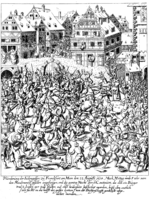
The Black-Death was a violent pestilence which ravaged Europe between 1348, and 1351, and is said to have carried off nearly half the population. A myth arose, especially in Germany, that the spread of the disease was due to a plot of the Jews to destroy Christians by poisoning the wells from which they obtained. All over Europe mobs against Jews arose and thousands of them were slain over these false accusations.
Poland grants rights to Jews
Casimir The Great, King of Poland grants rights to the Jews. Poland therefore attracts Jewish immigration from Germany and Russia and as a result becomes the most important Jewish center of Europe.
Expulsion from Spain (Spanish Inquisition)
An edict of expulsion was issued against the Jews of Spain by Ferdinand and Isabella (March 31, 1492). It ordered all Jews and Jewesses of whatever age to leave the kingdom in 4 months, leaving their houses, gold, silver, and money. Approximately 200 thousand fled Spain, 50,000 converted, and dozens of thousands were killed or died from diseases on the journey.
Maharal establishes academy
Moreinu ha-Rav Loew, the Maharal, establishes his academy in Prague and thus contributes to Jewish education and evolvement.
Establishment of the Hasidic & Misnagdim movements
Hasidism movement arose among the Polish Jews and won over nearly half of the Jewish masses there. It was founded by the Ba'al Shem Tov. His teachings assign the first place in religion not to religious dogma and ritual, but to the sentiment and the emotion of faith. This change gave rise to an opposition movement called the “Mitnagdim” led by the Vilna Ga'on, that most valued man's Talmudic learning and traditional rituals and prayers.
Napoleon's proclamation to the Jews
Napoleon has published a proclamation in which he invites all the Jews of Asia and Africa to gather under his flag in order to re-establish the ancient Jerusalem.
Emancipation and the emergence of the Jewish Enlightenment, Reform and Orthodox movements
Big changes in European society influenced its Jewish world. Emancipation, enlightenment, assimilation and the appearance of the Reform and the Orthodox movements are some of the main results.
The State of Israel established
The State of Israel was established on May 14, 1948 with the declaration of independence made by the Jewish People's Council, led by David Ben Gurion.