
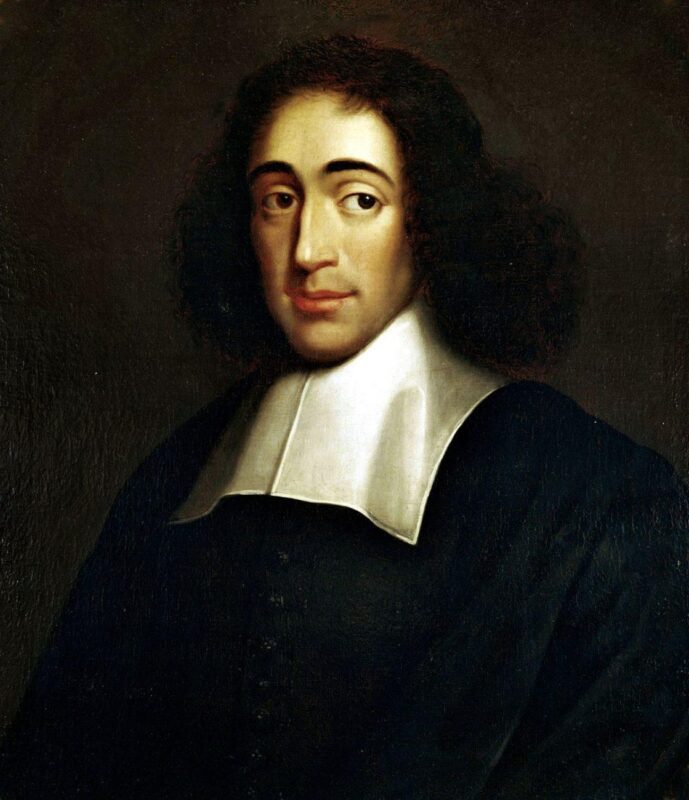
Son of Portuguese conversos in Amsterdam, educated in the community's Talmud Torah school and placed under a ban in 1656. His Ethics and his Treatise on religion and politics made him one of the founders of modern philosophy.
Who was Spinoza?
Baruch Spinoza was one of the founders of modern philosophy. His Ethics and his Theological-Political Treatise helped shape the modern ideas of freedom of thought, the separation of religion and state, and the historical study of the Bible. He was also a son of the Western Sephardi world: the child of Portuguese conversos who had returned to Judaism in Amsterdam, educated in his community’s school, and in 1656 placed under a ban by that same community. His story is part of Sephardic history, whatever one thinks of his ideas.
A converso family in Amsterdam
Bento de Espinosa, known in Hebrew as Baruch and later in Latin as Benedictus, was born in Amsterdam on 24 November 1632. His father, Michael de Espinosa, was a merchant who had come from Portugal; like many families of the “Portuguese Nation,” the Espinosas descended from Jews forced to convert in Iberia and had returned to Judaism once they reached the freedom of the Dutch Republic. Michael was an active member of the community and served on its governing board.
The young Baruch studied at the community’s Talmud Torah school, where he learned Hebrew, Bible and the commentaries, and some Talmud. His teachers there included Hakham Saul Levi Morteira, the community’s chief rabbi. After his father’s death in 1654 he ran the family’s import business for a time with his brother, but his interests were turning to philosophy, to the new science of Descartes, and to Latin, which he studied with a freethinking former Jesuit, Franciscus van den Enden.
The herem of 1656
On 27 July 1656 the Mahamad, the governing board of the Portuguese Jewish community of Amsterdam, pronounced a herem, a ban of excommunication, against him. The text speaks of “abominable heresies which he practiced and taught” and “monstrous deeds,” but does not say what they were. Historians believe he had come to deny that the soul is immortal, that the Torah was given by God, and that God has any part in human affairs: views he later developed in his writings. The ban was unusually severe, and it was never lifted.
The community’s reaction is easier to understand in its setting. Its members were former conversos, many of whom had grown up as Christians and were rebuilding Jewish life and belief from the ground up, under the eyes of a Calvinist city that tolerated them on condition that they kept their own house in order. An earlier dissenter, Uriel da Costa, had challenged the community’s beliefs a generation before and died tragically in 1640.
The philosopher
After the ban Spinoza left Amsterdam. He lived in Rijnsburg near Leiden, then in Voorburg, and finally in The Hague. He supported himself in part by grinding lenses for microscopes and telescopes, work that earned him the respect of scientists, and he corresponded with many of the leading thinkers of Europe. He lived simply and refused offers that would have limited his freedom, including a professorship at the University of Heidelberg.
The only book he published under his own name was an account of the philosophy of Descartes (1663). In 1670 he published, anonymously, the Theological-Political Treatise. It argued that the Bible should be studied like any other ancient text, through its language and history; that Moses did not write the whole Torah, building on hints he found in Avraham ibn Ezra; and that a free state must allow freedom of thought and speech. The book caused a scandal and was banned.
His masterpiece, the Ethics, was published only after his death. Written in the form of geometry, with definitions, axioms and proofs, it presents God as identical with nature, and argues that human freedom and happiness come from understanding the world and our place in it.
Death
Spinoza died in The Hague on 21 February 1677, at forty-four, probably of a lung disease made worse by the glass dust of his work. He was buried in the churchyard of the Nieuwe Kerk in The Hague.
Spinoza and the Sephardic world
Spinoza is claimed by many traditions, and his place in Jewish history has been argued over for three centuries. Some admirers, including David Ben-Gurion, called for the ban to be lifted; the Portuguese Jewish community of Amsterdam has declined to do so, most recently in 2015. Traditional Jewish thinkers have generally rejected his views, while modern philosophers, Jewish and non-Jewish, regard him as one of the greatest minds of the age.
His story belongs in Sephardic history because he was formed by it. The Portuguese Jews of Amsterdam, survivors of the Inquisition, built one of the most remarkable communities in Jewish history, and Spinoza’s education, his languages and even his questions came from that world. He shows both its intellectual vitality and the tensions it faced as former conversos rediscovered Judaism in the dawn of modern Europe.
Sephardic connection
Amsterdam-born son of Portuguese conversos educated within, and later excommunicated from, the Western Sephardic community

Sources
- Steven Nadler, Spinoza: A Life
- Steven Nadler, Baruch Spinoza, Stanford Encyclopedia of Philosophy
- Steven Nadler, Spinoza: A Life, 2nd ed. (Cambridge: Cambridge University Press, 2018)
- Steven Nadler, Spinoza's Heresy: Immortality and the Jewish Mind (Oxford: Oxford University Press, 2001)
- Yirmiyahu Yovel, Spinoza and Other Heretics (Princeton: Princeton University Press, 1989)


