Ingredients
Equipment
Method
- Activate Yeast: Dissolve the yeast in warm water. Allow to proof for 5–10 minutes until the mixture is foamy and active.
- Develop the Dough: In a food processor or stand mixer, combine the flour, olive oil, salt, and anise/fennel seeds. Add the yeast mixture and blend until the dough pulls away from the sides of the bowl.
- Knead and First Rise: Turn the dough out onto a floured surface. Knead by hand until the dough is smooth and elastic. Place in a greased bowl, cover, and let rise in a warm, draft-free area for 30 minutes.
- Second Rise: Punch down the dough and knead briefly. Cover and allow for a second rise of approximately 30 minutes.
- Shape: Divide the dough into two equal portions. Roll each half into a round, flat disk approximately the size of a pie pan.
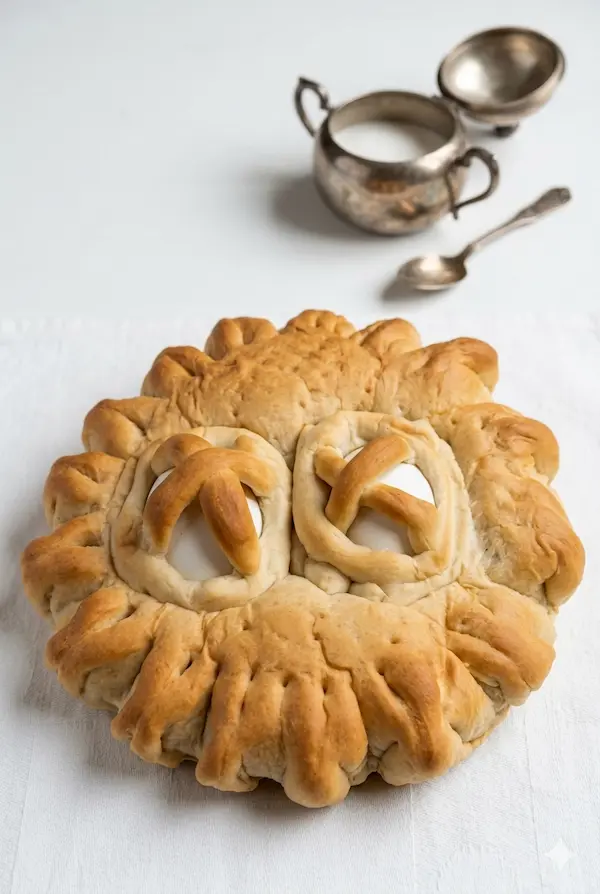
- Symbolic Detail: Using kitchen shears, cut vertical slits (1/4 inch deep) around the perimeter of the dough. Crimp groups of three slits together to create a scalloped edge. Prick the surface of the loaf with a fork to prevent bubbling.
- Embed Ritual Elements: Position the pre-soaked, hard-boiled eggs in the center of the loaf where the eyes would be on a face. Secure each egg by crisscrossing two thin strips of rolled dough over the top, then circle the base with an additional thin strip of dough to anchor it.
- Final Proof: Let the shaped loaves rise for an additional 30 minutes.
- Bake: Preheat oven to 325°F (165°C). Bake for 15 minutes, then rotate the pans to ensure even heat distribution. Bake for an additional 10 minutes, or until the loaf achieves a deep, golden-brown crust.
Notes
Baker’s Note: This is a traditional, rustic bread designed to be dense and sturdy to support the weight of the symbolic egg additions. Unlike modern, aerated loaves, this bread has a hearty, satisfying crumb.
Ritual Note (Hafrashat Challah): In accordance with the Mitzvah of separating dough, remove a small piece of the dough prior to shaping. This consecrated portion is to be burnt or wrapped and disposed of respectfully, symbolizing the Terumah (offering) from the Temple era.