
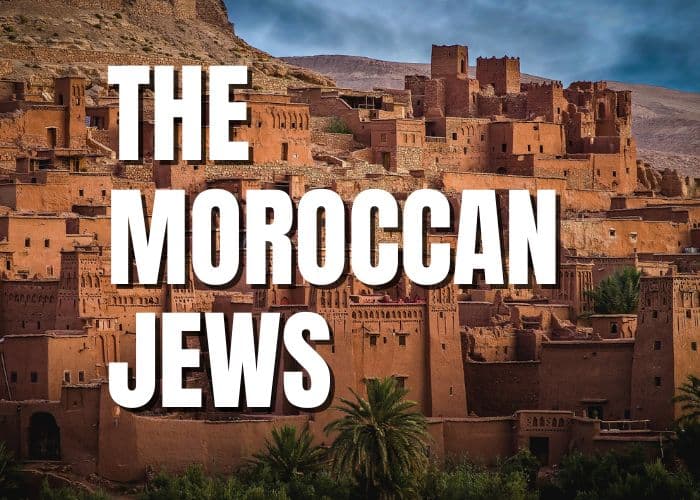
Moroccan Jews represent one of the oldest, most enduring Jewish communities in the world. Their presence in North Africa predates Islam, and their heritage reflects a remarkable blend of ancient Judaean, Berber, Arab, and Andalusian influences. For centuries, Moroccan Jews shaped the cultural, religious, and economic life of the Maghreb. Although the community is smaller today, its traditions, liturgy, and cuisine continue to flourish both in Morocco and across the global diaspora.
Early Jewish Presence in Morocco
Archaeological evidence and historical records confirm that Jews lived in Morocco long before the rise of Islam in the 7th century CE. In the Roman-era city of Volubilis, excavations revealed a Jewish epitaph dating to the 3rd century CE, while Byzantine and Vandal sources also point to Jewish settlements across North Africa. Oral traditions even suggest that Jews may have arrived after the Babylonian exile, finding refuge along the Mediterranean coast and in Morocco’s interior.

By the late antiquity period, Jewish communities were well established in towns and rural areas. These communities survived regime changes under Romans, Byzantines, and eventually Islamic dynasties, maintaining their traditions while contributing to local economies as traders, artisans, and scholars.
Seclusion in the Atlas Mountains: Preserving Ancient Practices
A defining feature of Moroccan Jewish history is the presence of rural and mountain communities in the Atlas and Maghreb regions. Often living in relative isolation alongside Berber (Amazigh) tribes, these Jews maintained practices with minimal outside interference. Scholars and ethnomusicologists note that their liturgical melodies, piyyutim (religious poems), and customs may have preserved elements close to biblical and Babylonian-era Judaism.

Because these communities were cut off from the cosmopolitan centers of the Middle East for centuries, their traditions did not undergo the same reforms or external influences. Their synagogue tunes, ritual chants, and local customs thus offer a living link to very ancient Jewish forms. While historians debate the exact degree of continuity with Babylonian or First Temple practices, many agree that mountain seclusion helped conserve exceptionally old layers of Jewish ritual life.
Moroccan Jews Before and After Islam
When Islam spread across North Africa in the 7th century CE, Jews were already established in Morocco. Islamic rule introduced both challenges and opportunities. Moroccan Jews, like other non-Muslim communities, were considered dhimmi (protected people), paying special taxes but allowed to practice their religion.
Over centuries, Moroccan Jews experienced alternating periods of tolerance and persecution. They contributed to Morocco’s economy as craftsmen, merchants, and financiers, while also suffering under rulers who restricted movement or imposed harsh conditions. Yet Jewish communities endured, adapting to urban centers like Fez, Marrakesh, and later Casablanca, as well as rural villages across the Atlas.
The Population Debate: How Many Jews Lived in Morocco?
By the 20th century, Morocco was home to the largest Jewish community in the Muslim world. Most estimates place the Jewish population around 250,000–350,000 in the 1940s–1950s. However, some researchers argue that this figure may significantly understate the true numbers, suggesting that Morocco’s Jewish population may have reached 500,000–600,000 at its peak.
Several factors explain this discrepancy:
- Superstition and the Evil Eye. In traditional Moroccan society, many families avoided declaring the true number of their children out of fear of attracting misfortune.
- Religious Restrictions. Jewish tradition itself discourages direct counting of individuals, sometimes leading communities to underreport population figures.
- Practical Census Challenges. Many Jews lived in small villages or mountain hamlets, making accurate colonial-era census records difficult. Some were missed due to mobility, remoteness, or ambiguous nationality status under French and Spanish protectorates.
While most scholarly consensus still places the population in the quarter-million to one-third-million range, the possibility of undercounting reflects both cultural practices and administrative limitations. Regardless of the exact figure, Morocco’s Jewish community was extraordinarily large and diverse, shaping Moroccan society in profound ways.
Culture of Moroccan Jews
Music and Liturgy
Moroccan Jewish liturgy is renowned for its distinctive melodies and piyyutim, often sung in Hebrew, Judeo-Arabic, or Judeo-Spanish. These tunes incorporate Andalusian and Berber influences, giving Moroccan synagogue music a rhythm and modal structure unique in the Jewish world.
Notable Moroccan Jewish musicians include Samy Elmaghribi, a master of Moroccan Jewish song; Raymonde El Bidaouia, who fused Arabic and Jewish musical traditions; and Emil Zrihan, a cantor and singer whose performances of piyyutim preserve centuries-old traditions. These artists helped bring Moroccan Jewish music into the international spotlight.
Cuisine
Moroccan Jewish cuisine is another defining cultural contribution. Rooted in Morocco’s rich culinary heritage, it blends sweet and savory flavors with abundant use of spices. Signature dishes include:
- Tagine – slow-cooked stew with meat, vegetables, preserved lemons, and saffron.
- Harira – a hearty tomato, chickpea, and lentil soup adapted for Jewish kitchens.
- Pastilla – a sweet and savory pastry of chicken, almonds, and cinnamon layered in delicate dough.
- Almond pastries and honey cakes, often prepared for holidays like Purim and Passover.
These recipes migrated with Moroccan Jews to Israel, France, and North America, where they remain staples of Sephardic cuisine.
Communities in Modern Morocco
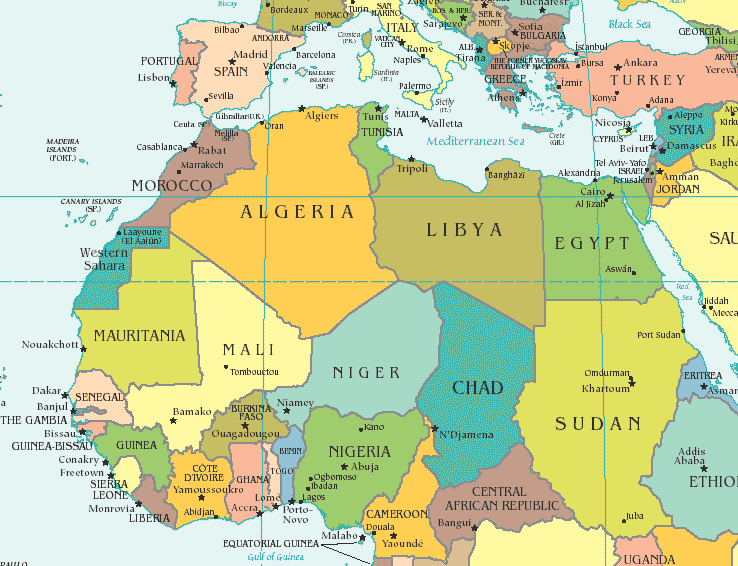
Today, Morocco’s Jewish population has shrunk dramatically due to emigration following independence in 1956, when many Jews relocated to Israel, France, Canada, or the United States. From hundreds of thousands in the mid-20th century, fewer than 2,500 Jews remain in Morocco today, with most concentrated in Casablanca and Marrakesh.
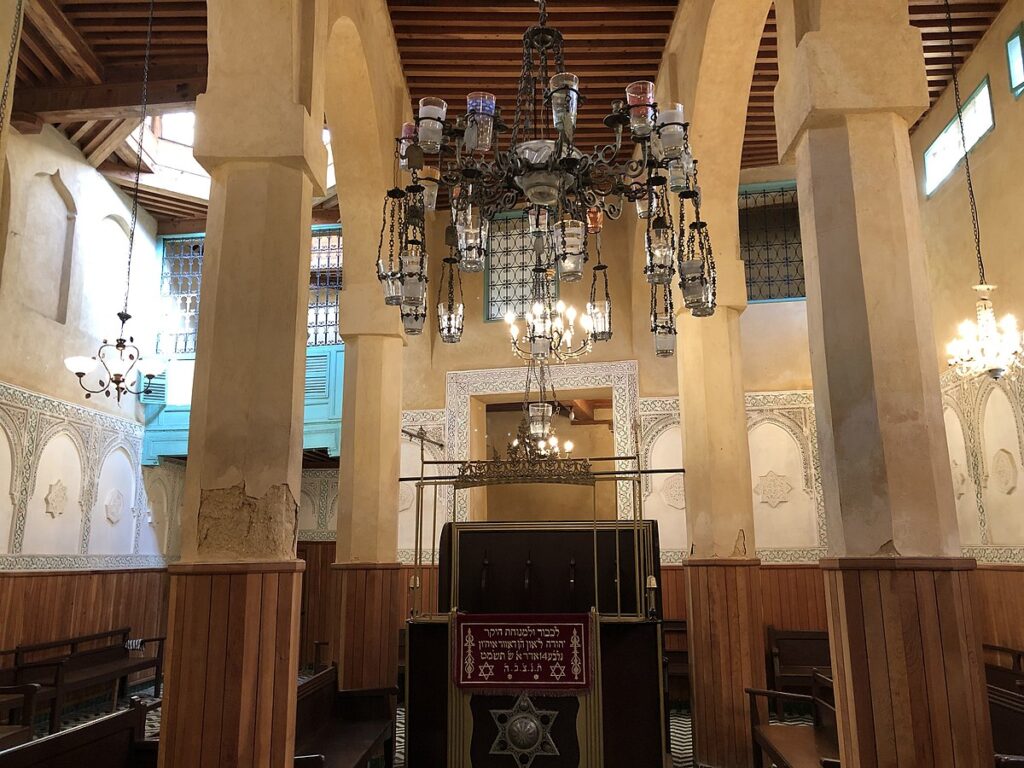
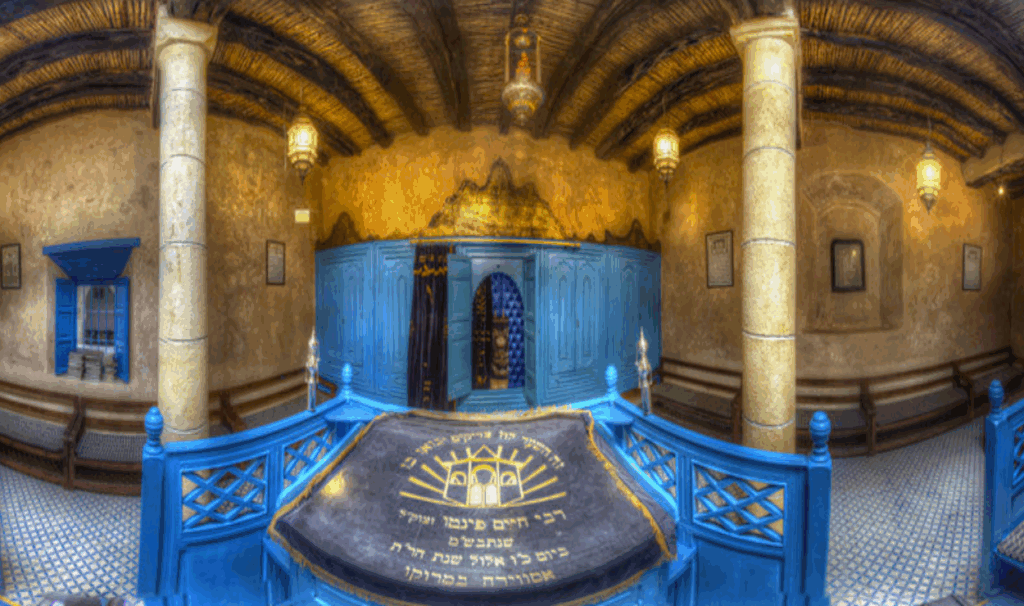
Despite its smaller size, the community continues to thrive. Historic synagogues such as Ibn Danan in Fez and Ettedgui in Casablanca have been restored, and Jewish cemeteries across the country serve as lasting reminders of Morocco’s Jewish past. The Moroccan government has also undertaken initiatives to preserve and showcase Jewish heritage as part of the national narrative.
Notable Moroccan Jews
Moroccan Jews have contributed to politics, arts, and culture both in Morocco and abroad.
- André Azoulay – Advisor to King Mohammed VI, advocating for Jewish-Muslim dialogue and economic development.
- David Amar – A prominent politician and community leader during Morocco’s independence movement.
- Gad Elmaleh – Internationally celebrated comedian and actor, born in Casablanca.
- Maurice El Medioni – Pianist blending Andalusian-Jewish and jazz traditions.
These figures embody the diverse ways Moroccan Jews have influenced global culture and politics.
Sephardic Genealogy in Morocco – Researching the family history of Moroccan Sephardi Jews
Legacy of Moroccan Jews
The legacy of Moroccan Jews is both national and global. In Morocco, their synagogues, cemeteries, music, and cuisine form an integral part of the country’s cultural fabric. Abroad, the Moroccan Jewish diaspora carries these traditions forward, ensuring their survival and adaptation in new contexts.
From their ancient roots before Islam to their preserved traditions in the Atlas Mountains, and from their thriving mid-20th-century population to today’s smaller but proud communities, Moroccan Jews stand as a testament to resilience, continuity, and cultural richness. Their history offers a unique window into Jewish life at the crossroads of Africa, Europe, and the Middle East.