Bukharan Jews are the Persian-speaking Jews of Central Asia, from Bukhara, Samarkand, Tashkent and the Fergana Valley in today’s Uzbekistan and Tajikistan. They called themselves Bnei Israel; Europeans named them after the Emirate of Bukhara. Their language, Bukhori, is a Jewish form of Tajik Persian, and their music, Shashmaqam, is the classical music of the region. Almost all left Central Asia after the Soviet Union collapsed and now live mainly in Israel and in Queens, New York. They are counted among the Mizrahi communities. See also Iranian Jews.
Origins
Bukharan Jews are a branch of Persian Jewry, and their own tradition traces them to the Babylonian exile; legends linking them to the tribes of Naphtali and Issachar belong to the lore of the Ten Lost Tribes. Jews lived along the Silk Road cities of Central Asia for many centuries, as merchants, dyers and weavers. In the 18th century many were forced to convert to Islam; the converts, called chala (“neither this nor that”), often kept Jewish practices in secret.
The Sephardi connection
In 1793 Rabbi Yosef Maimon, a kabbalist born in Tetouan, Morocco, who taught at a yeshiva in Safed, arrived in Bukhara to raise funds for it, and stayed. Finding the community cut off from rabbinic learning, he taught Torah and brought in Sephardi customs and prayer books. His reforms split the community at first, but his followers prevailed, and Bukharan Jews have followed the Sephardi rite ever since.
Modern era and departure
- Russian rule. Russia attacked the Emirate of Bukhara in 1868, with help from local Jews, and in the decades that followed Jews in the Russian-ruled territories gained rights equal to their Muslim neighbors. The years 1876–1916 are remembered as a golden age of trade and prosperity.
- Jerusalem. Bukharan Jews began settling in Jerusalem in the 1870s. In 1891 their association bought land for a new neighborhood, the Bukharan Quarter, designed by Conrad Schick with unusually wide streets. Rabbi Shimon Hakham helped organize it and printed books in Bukhori there.
- Soviet period. After the Soviet takeover, synagogues were closed and religious education was suppressed; many Jews were arrested in Stalin’s purges and again in the campaigns of the 1950s. Russian replaced Bukhori in schools.
- Emigration. Restrictions eased in the 1970s, and from the late 1980s through the 1990s almost all Bukharan Jews left Central Asia for Israel, the United States, Europe and Australia.
Religious life
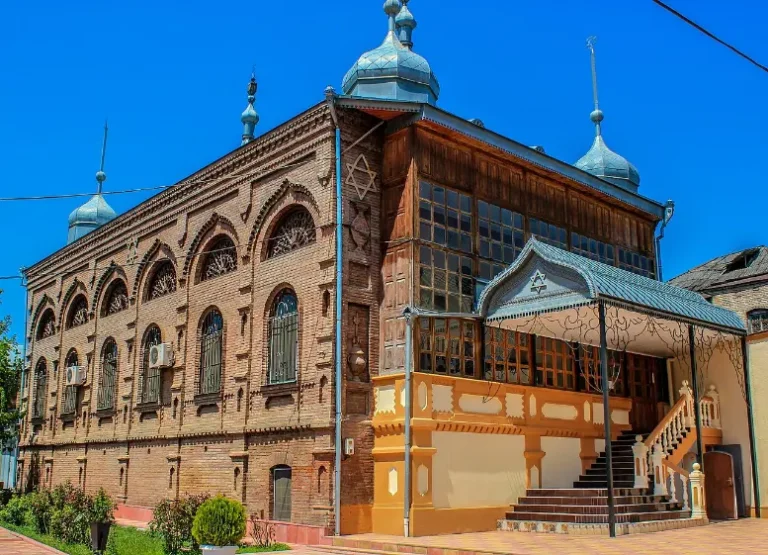
Bukharan Jews pray in the Sephardi rite introduced by Yosef Maimon, with their own melodies and customs. The synagogue of Bukhara still serves the small community there, and Bukharan congregations in Queens and Israel keep the community’s traditions.
Language, music and food
Bukhori, or Judeo-Tajik, is a Persian language close to Tajik and Dari, with Hebrew and Aramaic words, written in Hebrew letters and later in Latin and Cyrillic. Shimon Hakham translated the Bible and more than 50 books into it. Bukharan Jews were leading performers of Shashmaqam, the classical music of Bukhara; the singer Shoista Mullojonova was named People’s Artist of the Tajik SSR. The table includes osh palov (rice pilaf with meat), bakhsh (“green pilaf” with herbs) and oshi sabo, slow-cooked for Shabbat. See our Sephardic recipes.
The community today
Estimates of the worldwide Bukharan Jewish population run from 300,000 to 350,000, including about 160,000 in Israel and 50,000 or more in the New York area, centered on Forest Hills and Kew Gardens in Queens. Small communities remain in Tashkent and Bukhara.
Notable people
- Yosef Maimon 1741–1822 · Tetouan Kabbalist from Safed who came to Bukhara in 1793 and brought the community the Sephardi rite.
- Shimon Hakham 1843–1910 · Bukhara Rabbi and writer; translated the Bible into Bukhori and helped found Jerusalem’s Bukharan Quarter.
- Shoista Mullojonova 1925–2010 · Dushanbe Shashmaqam singer; People’s Artist of the Tajik SSR (1957); settled in Queens in 1991.
Sources and further reading
- Alanna E. Cooper, Bukharan Jews and the Dynamics of Global Judaism (Indiana University Press, 2012).
- “Bukharan Jews” and “Bukharan Quarter”, Wikipedia.
Revised October 2026 to correct errors in an earlier version of this page.