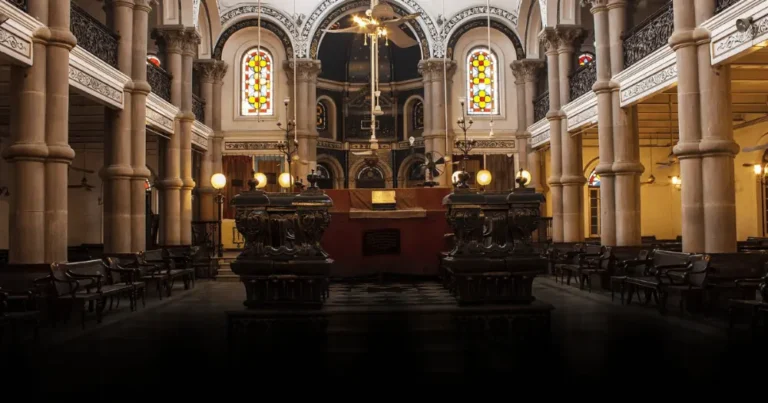
China’s best-known Jewish community lived in Kaifeng, the old imperial capital on the Yellow River, from about the 12th century. Descended mainly from Persian Jewish traders, the Kaifeng Jews kept a synagogue for some seven hundred years before the community faded in the 19th century. In modern times other Jews came to China: Baghdadi merchant families in Shanghai and Hong Kong, Russian Jews in Harbin, and nearly 20,000 refugees from Nazi Europe in wartime Shanghai. This page covers all of them. See also Indian Jews and Iranian Jews.
The Kaifeng Jews
Most historians date the Kaifeng community to the Song dynasty (960–1279), and some to no later than 1120. According to stone inscriptions the community erected, the first synagogue was built in 1163; the stelae, dated from 1489 to the 1670s, record the community’s history in Chinese. In 1605 a Kaifeng Jew named Ai Tian met the Jesuit Matteo Ricci in Beijing and described a congregation of about 1,000. A Yellow River flood in 1642 destroyed the synagogue and killed many in the community; it was rebuilt, but Jewish practice declined, and the synagogue was dismantled between 1850 and 1866.
Several hundred people in Kaifeng today trace their ancestry to the community, and a few dozen take part in Jewish activities. Since 2015 they have faced increased government pressure. Some descendants have moved to Israel and formally converted to Judaism.
Baghdadi Jews in Shanghai and Hong Kong
From the 19th century, Baghdadi Jewish families such as the Sassoons and Kadoories, many of them based in India, built trading and property businesses in Shanghai and Hong Kong. They followed the Baghdadi Sephardi rite; see Iraqi Jews and Indian Jews.
Wartime Shanghai
In the late 1930s, Shanghai was one of the few places Jews fleeing Nazi Germany and Austria could enter without a visa. In February 1943 the occupying Japanese forced about 18,000 stateless refugees into a “designated area” in Hongkou; it was not walled, but it was patrolled and required passes. Victor Sassoon and Horace Kadoorie helped organize housing and aid. The area was liberated in September 1945, and most refugees later left for Israel, the United States and Australia. The Shanghai Jewish Refugees Museum, in the former Ohel Moshe Synagogue, tells their story.
The community today
Small Jewish communities, most of them foreign residents, live in Shanghai, Beijing and Hong Kong today. Kaifeng’s descendants remain a separate story of a community that kept its identity for centuries in the heart of China.
Sources and further reading
- Irene Eber, Chinese and Jews: Encounters Between Cultures (Vallentine Mitchell, 2008).
- “Kaifeng Jews” and “Shanghai Ghetto”, Wikipedia.
Revised October 2026 to correct errors in an earlier version of this page.