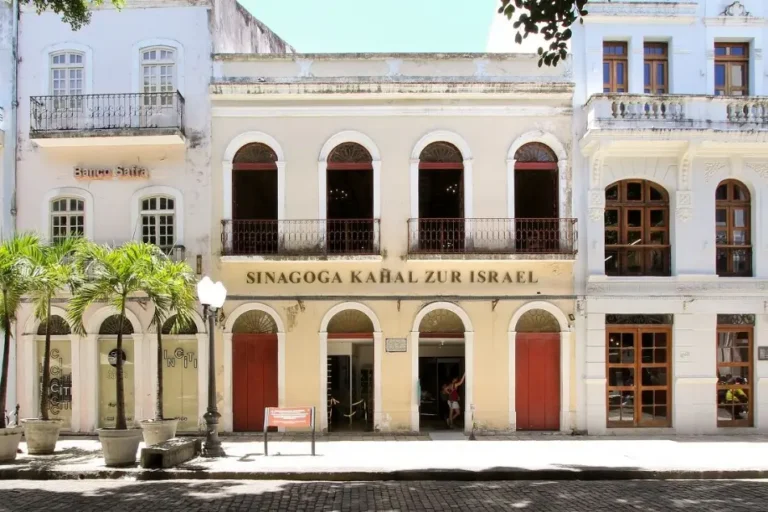
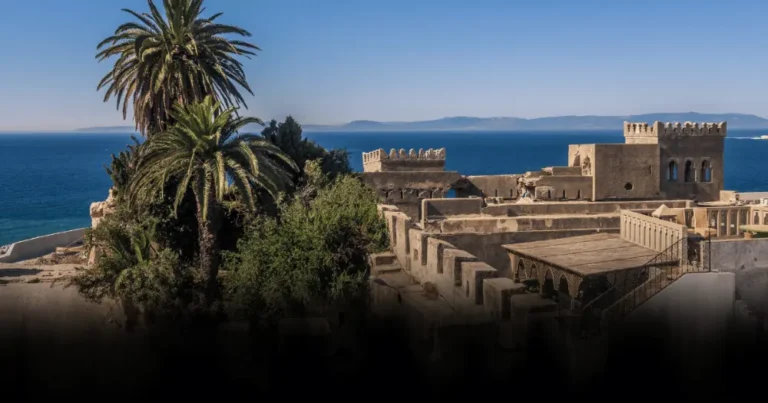
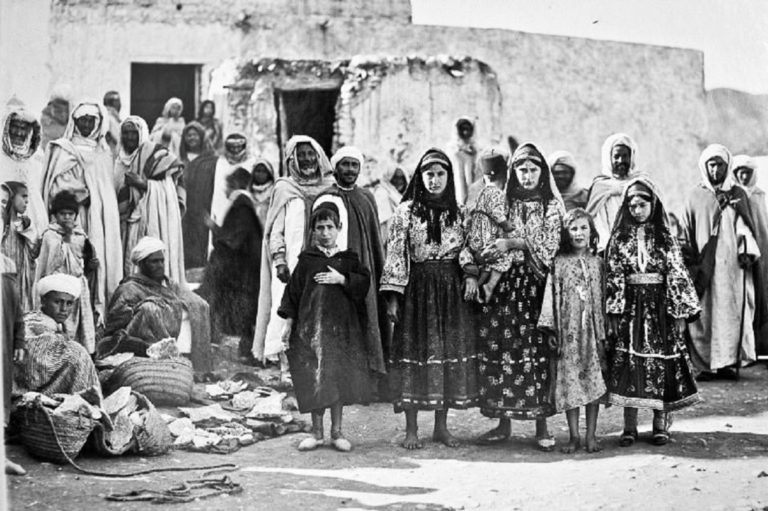
Tunisia has one of the oldest Jewish communities in North Africa and one of the few still living there: on the island of Djerba, Jews have prayed at the El Ghriba synagogue for many centuries. In Tunis, two communities lived side by side for two hundred years: the Twansa, Tunisia’s long-established Jews, and the Grana, Sephardi families who came from Livorno in Italy. About 105,000 Jews lived in Tunisia before independence in 1956; most left for France and Israel. See also Libyan Jews, Algerian Jews and North African Sephardim.
Origins
The earliest firm record of Jews in Tunisia dates to the 2nd century CE, in Roman Carthage. Its Gammarth necropolis has some 200 rock-cut tombs with Jewish symbols and inscriptions, and a synagogue of the 3rd to 5th century was found at Hammam-Lif in 1883. Older stories, that Israelites helped found Carthage or that Jewish mercenaries arrived in the 4th century BCE, are speculation.
On Djerba, tradition holds that Kohanim, priests, settled after the destruction of the First Temple in 586 BCE and brought a door or stone from the Temple, kept in the El Ghriba synagogue. The legend was first written down in 1849; the synagogue itself is a place of pilgrimage every Lag BaOmer.
The Sephardi connection
Sephardi families reached Tunisia from the 16th century, and from the early 17th century Portuguese and Spanish converso families came from Livorno, the Tuscan port where they had returned to Judaism; see Italian Jews. Known as Grana (from Livorno, Gorna in Arabic), they spoke Italian and Spanish, traded across the Mediterranean and kept their own customs. The established Tunisian Jews were called Twansa.
In 1710 the Grana broke away to form their own congregation, and an agreement of 1741 divided the two communities, with separate rabbis, synagogues, courts and cemeteries. The Grana, about 8% of Tunisian Jews, paid a third of the community’s tax. The separation was abolished in 1899, and the two communities gradually merged in the 20th century.
Modern era and departure
- The Hara. The Jewish quarter of Tunis, the Hara, was closed at night and served as a ghetto until 1857. That year the Fundamental Pact gave Jews legal equality.
- 1942–1943. German forces occupied Tunisia from November 1942 to May 1943. They set up about forty labor camps and conscripted about 5,000 Jewish men for forced labor. Read more: Sephardim in the Holocaust.
- After 1956. About 105,000 Jews lived in Tunisia before independence. Large departures followed the Bizerte crisis of 1961 and the Six-Day War of 1967; most went to France and Israel.
- 2002 and 2023. On April 11, 2002, an al-Qaeda suicide bomber attacked El Ghriba, killing 19 people. On May 9, 2023, during the Lag BaOmer pilgrimage, a gunman killed two Jewish visitors and three security officers.
Religious life
Tunisian Jews pray in a North African Sephardi rite. Djerba’s two villages, Hara Kebira and Hara Sghira, are known for their strict religious life, many synagogues and Hebrew printing; the Lag BaOmer pilgrimage to El Ghriba still draws visitors from Israel and France.
Language, music and food
Twansa families spoke Tunisian Judeo-Arabic, the Grana Italian, and French spread through Alliance schools. In the 1920s the singer Habiba Msika, from the Hara of Tunis, became one of North Africa’s first recording stars. Tunisian Jewish cooking includes bkaila (a dark stew of spinach and beans), boulettes (meatballs) and the Shabbat t’fina, slow-cooked overnight. See our Sephardic recipes.
The community today
About 1,500 Jews lived in Tunisia in 2017, most of them on Djerba and in Tunis. Large Tunisian Jewish communities live in France, especially Paris, and in Israel.
Notable people
- Habiba Msika 1903–1930 · Tunis Singer and actress, one of North Africa’s first recording stars; murdered in 1930.
- Victor “Young” Perez 1911–1945 · Tunis World flyweight boxing champion, 1931–32; killed on a death march from Auschwitz.
- Albert Memmi 1920–2020 · Tunis Writer, author of The Pillar of Salt and The Colonizer and the Colonized.
- Gisèle Halimi 1927–2020 · La Goulette Lawyer and campaigner for women’s rights in France.
- Michel Boujenah b. 1952 · Tunis Actor and director; César Award for Three Men and a Cradle.
Sources and further reading
- Lucette Valensi and Abraham L. Udovitch, The Last Arab Jews: The Communities of Jerba, Tunisia (Harwood, 1984).
- “History of the Jews in Tunisia”, Wikipedia.
- United States Holocaust Memorial Museum, “Labor and Internment Camps in North Africa”.
- “Ghriba synagogue bombing” and “2023 Djerba shooting”, Wikipedia.
- Albert Memmi, The Pillar of Salt (1953), a novel of growing up in the Hara of Tunis.
Revised October 2026 to correct errors in an earlier version of this page.