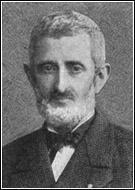
Rabbi of Livorno, born to Moroccan parents, who taught for half a century. His Israel and Humanity presents Judaism as a universal faith with a message for all peoples, and he defended the Kabbalah against its modern critics.
Who was Rabbi Eliyahu Benamozegh?
Rabbi Eliyahu Benamozegh was the rabbi of Livorno, in Italy, and one of the most original Jewish thinkers of the nineteenth century. Born to Moroccan parents, he taught in Livorno for half a century. His great book, Israel and Humanity, presents Judaism as a universal faith with a message for all peoples, and he was a passionate defender of the Kabbalah against its modern critics.
Livorno
Eliyahu Benamozegh was born in Livorno in 1823, to parents who had come from Fez in Morocco. His father died when he was a small child, and he was raised by his mother’s brother, Rabbi Yehuda Coriat, a kabbalist from Morocco, who taught him Torah and Kabbalah. Livorno was then the great Sephardic port of the Mediterranean, linked by trade and family to North Africa and the Levant.
As a young man he worked in business, but he devoted himself increasingly to study, and he became a rabbi and teacher. For about fifty years he taught theology at the rabbinical college of Livorno, and he served as one of the city’s rabbis.
Defender of the Kabbalah
In the nineteenth century, many Jewish scholars in Europe dismissed the Kabbalah as a late superstition. Rabbi Benamozegh disagreed. In Ta’am LeShad he answered the arguments against the antiquity of the Zohar raised by the Venetian rabbi Leon of Modena, and in other works he argued that Kabbalah is the ancient theology of Israel and the key to understanding the Torah.
Em LaMikra
His commentary on the Torah, Em LaMikra, joins traditional interpretation to the knowledge of history, archaeology and comparative religion of his day. Its openness to the scholarship of the time made it controversial, and some rabbis in Syria condemned it. It remains a remarkable attempt to read the Torah in the light of modern learning without giving up tradition.
Israel and Humanity
Rabbi Benamozegh’s best-known work is Israel and Humanity, written in French and published after his death. In it he argued that Judaism contains two laws: the Torah for the people of Israel, and the seven laws of the children of Noah for all humanity. Israel’s mission, he wrote, is to be a priest for the nations, teaching a universal faith in one God without asking others to become Jews.
He put these ideas into practice. When a young French Catholic, Aimé Pallière, came to him wishing to convert to Judaism, Rabbi Benamozegh advised him instead to embrace the faith of Noah, and Pallière became a lifelong friend of the Jewish people and published his teacher’s book. He also wrote Jewish and Christian Ethics, a comparison of the two traditions.
Death
Rabbi Eliyahu Benamozegh died in Livorno in 1900. His hilula is observed on 7 Adar.
Rabbi Benamozegh’s legacy for Sephardim
Rabbi Benamozegh brought the Kabbalah of Morocco and the openness of Livorno into conversation with the modern world. His vision of a Judaism that speaks to all humanity, while remaining faithful to tradition, still inspires readers today, and the Noahide movement looks to him as one of its founders.
Sources
- Elijah Benamozegh, Israel and Humanity, trans. and ed. Maxwell Luria (New York: Paulist Press, 1995)
- Alessandro Guetta, Philosophy and Kabbalah: Elijah Benamozegh and the Reconciliation of Western Thought and Jewish Esotericism (Albany: SUNY Press, 2009)