
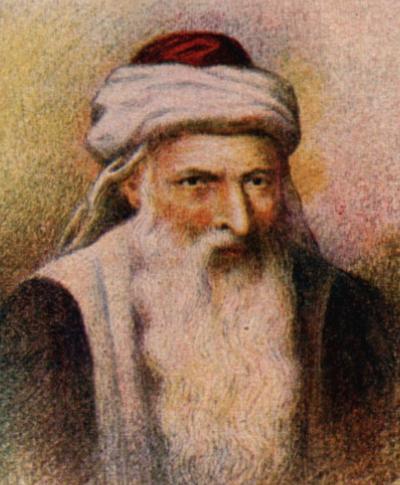
Exiled as a child, he settled in Safed and wrote the Beit Yosef and its summary, the Shulhan Arukh, the code that still governs Jewish practice. For Sephardim his rulings are binding: he is Maran, our master.
Who was Maran?
Rabbi Yosef Karo is the author of the Shulhan Arukh, the code of Jewish law that Jews everywhere still consult every day, and of the Beit Yosef, the vast work on which it rests. Sephardim call him simply Maran, “our master,” because his rulings are the law their communities follow. Born in Iberia shortly before the Expulsion, he spent his youth as a refugee in the Ottoman Empire and his last four decades in Safed, where he led one of the most remarkable gatherings of scholars and mystics in Jewish history.
From Iberia to the Ottoman Empire
Yosef Karo was born in 1488. Tradition places his birth in Toledo; some historians think the family was then living in Portugal. When the Jews were expelled from Spain in 1492, the Karo family went to Portugal, and when Portugal forced its Jews to convert in 1497, they fled again, reaching the Ottoman Empire. His father, Rabbi Efraim Karo, a respected Talmudist, was his first teacher and died while Yosef was still young; his uncle, Rabbi Yitzhak Karo, then took him into his home.
Like thousands of exiles, the family rebuilt its life in the Balkans. Yosef Karo lived in Nikopol on the Danube, in Adrianople (Edirne), and for a time in Salonica, the greatest Sephardi city of the age. He married, taught, and gathered students, and in Adrianople, in 1522, he began the work that would occupy him for twenty years.
The Beit Yosef
By the sixteenth century, Jewish law had grown into a forest of opinions. The exiles from Spain, Portugal, Provence and elsewhere arrived in Ottoman cities with different customs, and every community had its own authorities. Rabbi Karo set out to bring order to it all. He took as his framework the Arba’ah Turim of Rabbi Yaakov ben Asher, son of the Rosh, and wrote a commentary that traced every law back to the Talmud and followed it through every major authority up to his own day.
Where the authorities disagreed, he adopted a simple, bold rule. He would follow the majority of the three great pillars of halakha: the Rif, the Rambam and the Rosh. Two of them were Sephardim, and through this method the halakhic tradition of Sepharad became the backbone of his rulings. He began the Beit Yosef in Adrianople in 1522 and finished it in Safed in 1542; it was printed in Italy over the following decade.
Safed
Around 1536 Rabbi Karo settled in Safed, in the Galilee. The town had become a magnet for exiles and scholars, and for a few extraordinary decades it was the spiritual capital of the Jewish world. There Rabbi Karo became a leading member, and later the head, of the rabbinic court, and taught at his own academy. The synagogue that bears his name still stands in Safed’s old city.
In 1538 his teacher, Rabbi Yaakov Berab, attempted to revive the ancient rabbinic ordination, the semikha, which had lapsed in late antiquity. Rabbi Berab ordained a small group of sages, Rabbi Karo among them. The revival was opposed by the rabbis of Jerusalem and did not last, but Rabbi Karo in turn ordained Rabbi Moshe Alshikh, who ordained Rabbi Hayyim Vital, the student of the Arizal.
Safed was also the home of Rabbi Moshe Cordovero, who was Rabbi Karo’s student in halakha, and of Rabbi Shlomo Alkabetz, author of Lekha Dodi. The custom of staying awake through the night of Shavuot to study Torah grew from a night Rabbi Karo spent with Rabbi Alkabetz and their companions before they settled in Safed, as Rabbi Alkabetz recorded in a famous letter.
The mystic: Maggid Mesharim
Rabbi Karo was not only a jurist. For decades he kept a mystical diary, published after his death as Maggid Mesharim. In it he recorded the words of a heavenly teacher, a maggid, whom he identified with the Mishnah itself, speaking to him at night after he had studied. The maggid urged him to greater humility and piety, encouraged his legal work, and spoke of his hope to die a martyr’s death, as his admired contemporary Shlomo Molcho had done. The great scholar R. J. Zwi Werblowsky called him a “lawyer and mystic,” and in Safed the two belonged together.
The Shulhan Arukh
The Beit Yosef was too large for daily use, so Rabbi Karo condensed its conclusions into a short handbook that gave only the final ruling, clearly and briefly. He called it Shulhan Arukh, “a set table,” so that anyone could find the law as easily as a meal laid out on a table. It was first printed in Venice in 1565.
It covers all of the Jewish law that applies after the destruction of the Temple, in four sections that follow the Tur: Orah Hayyim on daily life, prayer, Shabbat and festivals; Yoreh De’ah on dietary laws and many ritual matters; Even HaEzer on marriage and divorce; and Hoshen Mishpat on civil law. Rabbi Moshe Isserles of Kraków soon added glosses, the Mappah, giving the customs of Ashkenazi Jewry, and the combined work became the common code of the whole Jewish people. Commentaries on it fill whole libraries.
Other works
Rabbi Karo also wrote the Kesef Mishneh, a commentary on the Rambam’s Mishneh Torah that identifies the sources of its rulings and answers the objections of the Ra’avad. His responsa were collected as Avkat Rokhel and Teshuvot Beit Yosef, and his Kelalei HaTalmud discusses the methods of Talmudic interpretation.
Death and burial
Rabbi Yosef Karo died in Safed on 13 Nisan 5335, in the spring of 1575, at the age of about eighty-seven, and was buried in the town’s old cemetery. His hilula falls on 13 Nisan, on the eve of the preparations for Pesah, and his tomb in Safed is visited all year.
Maran’s legacy for Sephardim
For Sephardi and Mizrahi Jews, Maran’s rulings are binding. “We have accepted the rulings of Maran” is a principle repeated by Sephardi authorities for four centuries, from Morocco to Iraq. Local customs survived alongside it, and different communities developed their own traditions of interpretation, but the Shulhan Arukh became the shared law of the Sephardic world.
In the twentieth century Hakham Ovadia Yosef made “restoring the crown to its former glory” his life’s mission: bringing Sephardim in Israel back to Maran’s rulings after generations of mixing with other customs. His son, Rabbi Yitzhak Yosef, set out those rulings for daily use in Yalkut Yosef. When a Sephardi Jew today asks “What does Maran say?”, the answer still begins with the book a refugee from Iberia wrote in Safed nearly five centuries ago.
Sephardic connection
Child exile from Iberia who developed the legal synthesis that became foundational for Sephardic and wider Jewish practice

Teachers and students
Sources
- R. J. Zwi Werblowsky, Joseph Karo: Lawyer and Mystic
- Joseph Ben Ephraim Caro, Encyclopaedia Judaica
- R. J. Zwi Werblowsky, Joseph Karo: Lawyer and Mystic (Oxford: Oxford University Press, 1962)
- Lawrence Fine, ed., Safed Spirituality: Rules of Mystical Piety, The Beginning of Wisdom (New York: Paulist Press, 1984)
- "Caro, Joseph ben Ephraim," Encyclopaedia Judaica, 2nd ed. (2007)


