Fleeing the Almohads, he passed through Fez to Fustat, where he served as court physician and leader of Egyptian Jewry. His Mishneh Torah codified all of Jewish law, his Guide reconciled faith and reason, and his rulings shaped Sephardi halakha for every generation after him.
Who was the Rambam?
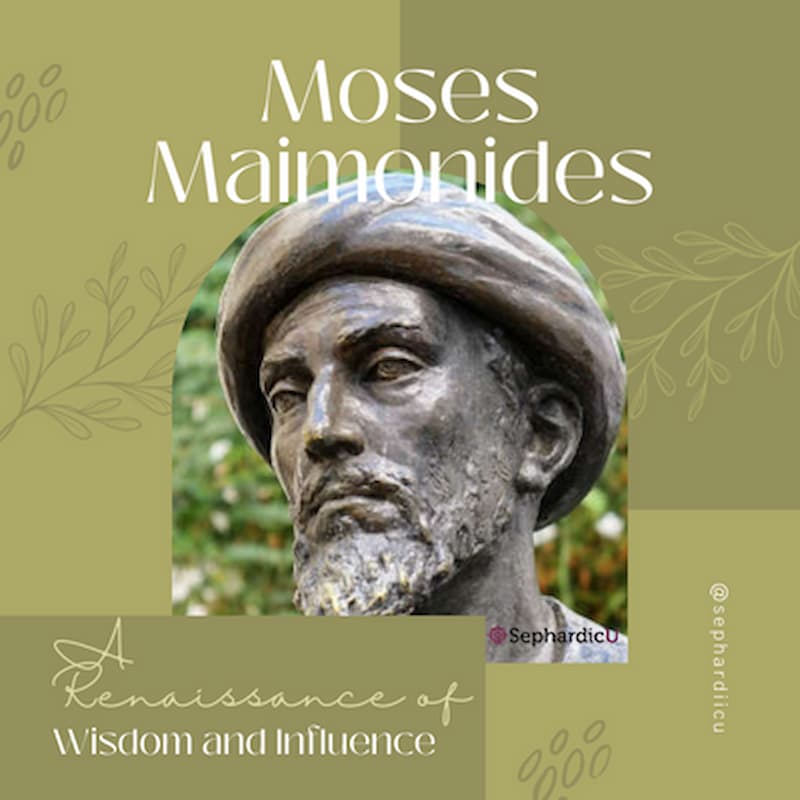
Rabbi Moshe ben Maimon, known to Jews as the Rambam and to the wider world as Maimonides, is the most influential Jewish thinker since the close of the Talmud. He wrote the first complete code of Jewish law, the central work of medieval Jewish philosophy, and a commentary on the Mishnah that is still studied today. He was also one of the leading physicians of his age. Jewish tradition sums up his standing in one line: “From Moshe to Moshe, there arose none like Moshe.”
He was a son of Sepharad. Everything he wrote carries the stamp of al-Andalus, where Torah, Arabic science and Greek philosophy were studied side by side. Long after he had left Spain, he still called himself “the Sephardi” in his writings.
Córdoba and the years of wandering
Moshe ben Maimon was born in Córdoba, the great city of Muslim Spain, to a family of rabbinic judges. Jewish tradition places his birth on the eve of Passover in 1135; many modern historians prefer 1138, based on a note in one of his own works. His father, Rabbi Maimon, was a dayyan and a student of the Ri Migash, the head of the academy of Lucena, and he taught his son the Talmud as it had been studied in Spain since the days of the Rif.
In 1148 the Almohads, a North African movement that refused to tolerate Jews or Christians, conquered Córdoba. Jews were given the choice of conversion, exile or death. The family left, and for about a decade lived as wanderers, probably in southern Spain. Around 1160 they settled in Fez, in Morocco, then also under Almohad rule, where Jews had to hide their practice. Out of this experience came one of the Rambam’s first works, the Iggeret HaShmad (Epistle on Forced Conversion). In it he rejected the view that Jews forced to profess Islam had left the Jewish people, and urged them to keep every commandment they could and to leave for a place where they could live openly.
In 1165 the family sailed to Acre in the Land of Israel, visited Jerusalem and Hebron, and finally settled in Egypt, in Fustat, the old city beside Cairo.
Egypt: scholar, leader and physician
At first the Rambam was free to study while his younger brother David supported the family as a merchant in the trade with India. Then David drowned in the Indian Ocean, and the family fortune went down with him. The Rambam later wrote that for a year he lay ill with grief, and that years afterward the pain had not left him. He turned to medicine to earn a living.
He became one of the best-known physicians in Egypt and served at the court of Saladin’s vizier, al-Qadi al-Fadil, and later of Saladin’s son al-Afdal. In a famous letter to his translator, Rabbi Shmuel ibn Tibbon, he described his day: hours at court in Cairo, then a house full of patients, Jews and non-Jews, until night, with Shabbat the only day left for his community and his students. He wrote ten medical works in Arabic, including a Regimen of Health for al-Afdal and treatises on asthma and poisons.
He also led the Jewish community of Egypt. Letters from across the Jewish world reached him with questions, and his responsa answered communities from Yemen to Provence. When the Jews of Yemen were facing forced conversion and a false messiah, his Iggeret Teiman (Epistle to Yemen) gave them courage. Yemenite Jews still count him among their greatest teachers.
The Commentary on the Mishnah and the Thirteen Principles
The Rambam completed his Commentary on the Mishnah in Egypt in 1168, after working on it during the years of wandering. Written in Judeo-Arabic, it explains each mishnah plainly and states the halakha that follows from it. It was the first commentary to cover the whole Mishnah.
Two of its introductions became classics. The introduction to Pirkei Avot, known as the Shemonah Perakim (Eight Chapters), is a short guide to ethics and the health of the soul. The introduction to the chapter Helek in tractate Sanhedrin sets out thirteen principles of Jewish faith, from the existence and unity of God to the coming of the Messiah and the resurrection of the dead. Those principles became the basis of the hymn Yigdal and of the Ani Ma’amin recited in many prayer books.
The Mishneh Torah
Around 1178 the Rambam finished the work he called Mishneh Torah, “the second to the Torah,” also known as the Yad HaHazakah because its fourteen books add up to yad, the Hebrew number fourteen. Nothing like it had been written before. It covers the whole of Jewish law, including the laws of the Temple and the sacrifices that no longer applied, in clear Mishnaic Hebrew, without citing the debates behind each ruling. He wanted anyone who knew the written Torah and his book to know the whole Oral Law.
The book was revered, and also attacked. Rabbi Avraham ben David of Posquières, the Ra’avad, wrote sharp critical glosses, objecting above all to rulings given without sources. That gap was filled by generations of commentators, and the work became one of the foundations of halakha. A companion work, Sefer HaMitzvot, lists the 613 commandments.
The Guide for the Perplexed
Around 1190 the Rambam completed Moreh Nevukhim, the Guide for the Perplexed, written in Judeo-Arabic for a student who had studied philosophy and was troubled by the plain sense of the Torah. The Guide argues that the Torah and true philosophy cannot contradict each other. It explains that the Torah’s descriptions of God with a body or emotions must be read figuratively, since God has no body and can only be described by what He is not. It examines prophecy, providence, the problem of evil and the reasons for the commandments.
The Guide was translated into Hebrew by Shmuel ibn Tibbon, who corresponded with the Rambam about the translation, and later into Latin, where it was read by Thomas Aquinas and, centuries later, by Spinoza and Leibniz. It is the most widely read work of Jewish philosophy ever written.
Death and the great controversy
The Rambam died in Fustat on 20 Tevet 4965, in December 1204. Jews and Muslims in Egypt mourned him publicly. According to a long tradition, his body was taken to Tiberias in the Land of Israel for burial, and his tomb there is visited by thousands every year, especially on his hilula. His son, Rabbi Avraham Maimuni, succeeded him as leader of Egyptian Jewry.
After his death, the Guide and the philosophical parts of the Mishneh Torah sparked a bitter dispute, known as the Maimonidean controversy, between his defenders and rabbis in Provence and northern France who feared that philosophy would weaken faith. In the early 1230s his books were burned in Montpellier. The controversy did nothing to reduce his authority. Within a few generations, his works stood at the center of Jewish learning everywhere.
The Rambam’s legacy for Sephardim
For the Sephardic world, the Rambam is not only a great sage of the past; his rulings are part of daily practice. When Maran, Rabbi Yosef Karo, wrote the Beit Yosef and the Shulhan Arukh, he decided the law by following the majority of three great authorities: the Rif, the Rosh and the Rambam. Maran also wrote the Kesef Mishneh, a commentary that traces the sources of the Rambam’s rulings. Because two of Maran’s three pillars, the Rif and the Rambam, were Sephardim, Sephardic halakha to this day carries the Rambam’s voice. In Yemen, many communities follow the Rambam’s rulings directly.
His approach also shaped how Sephardim learn: clear thinking, respect for science, a law accessible to every Jew, and faith that does not fear reason. Hakham Ovadia Yosef, who restored the authority of Maran’s rulings in our generation, often turned to the Rambam’s words. Today, thousands follow the daily study cycle of the Mishneh Torah, finishing the whole work together.
Sephardic connection
Iberian-born scholar whose mature career in Egypt produced foundational works of Sephardic law, philosophy, medicine, and communal governance
Sources
- Herbert A. Davidson, Moses Maimonides: The Man and His Works
- Maimonides, Encyclopaedia Judaica
- Joel L. Kraemer, Maimonides: The Life and World of One of Civilization's Greatest Minds (New York: Doubleday, 2008)
- Herbert A. Davidson, Moses Maimonides: The Man and His Works (New York: Oxford University Press, 2005)
- Moshe Halbertal, Maimonides: Life and Thought, trans. Joel Linsider (Princeton: Princeton University Press, 2014)
- Kenneth Seeskin, "Maimonides," Stanford Encyclopedia of Philosophy
- "Maimonides, Moses," Encyclopaedia Judaica, 2nd ed. (2007)