


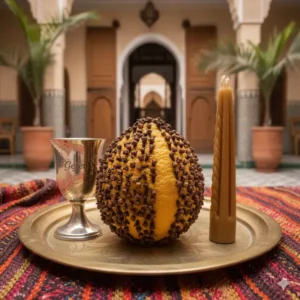


Shaking the lulav and etrog is one of the most recognizable mitzvot of Sukkot. Each day of Sukkot except Shabbat, Jews take the Four Species—the lulav, hadassim, aravot, and etrog—and perform a series of movements known as na’anuim.
The basic mitzvah is the same for all Jewish communities, but the details of the na’anuim differ among Sephardi and Ashkenazi traditions.
This guide explains how to take and wave the lulav according to the traditional Sephardi practice, including the blessings, the six directions, and the na’anuim performed during Hallel. It also explains the principal differences between Sephardi and common Ashkenazi practice.
What Are the Four Species?
The Four Species, or Arba’at HaMinim (אַרְבַּעַת הַמִּינִים), are:
- Lulav — לוּלָב — a palm branch
- Hadassim — הֲדַסִּים — myrtle branches
- Aravot — עֲרָבוֹת — willow branches
- Etrog — אֶתְרוֹג — citron
The lulav, hadassim, and aravot are held together in one hand. The etrog is held separately in the other hand.
The Torah-level mitzvah of the Four Species applies on the first day of Sukkot. After the destruction of the Temple, Rabban Yoḥanan ben Zakkai instituted taking the Four Species throughout the seven days of Sukkot as a remembrance of the Temple.
The Four Species are not taken on Shabbat.
When Do You Take the Lulav?
The Four Species may be taken during the daytime of Sukkot, from sunrise until sunset, except on Shabbat.
The customary Sephardi practice is to take the lulav during the morning prayers, generally after Shacharit and before Hallel.
If someone did not take the lulav at that time, the mitzvah can still be performed later in the day.
How to Hold the Lulav and Etrog
According to the Sephardi practice described by Chacham Ovadia Yosef, hold the lulav, hadassim, and aravot in the right hand. The etrog is taken in the left hand after the blessing.
The four species should be held together during the na’anuim.
The lulav bundle should be held in its natural orientation, with the top pointing upward.
Before the Blessing
Hold:
Right hand: Lulav + Hadassim + Aravot
Left hand: the etrog is not yet brought together with the lulav.
Some Sephardi traditions specifically emphasize that the blessing is recited before the etrog is brought together with the lulav, thereby ensuring that the blessing precedes the fulfillment of the mitzvah.
The Blessing on the Lulav
Recite:
Hebrew
בָּרוּךְ אַתָּה יְיָ אֱלֹהֵינוּ מֶלֶךְ הָעוֹלָם אֲשֶׁר קִדְּשָׁנוּ בְּמִצְוֹתָיו וְצִוָּנוּ עַל נְטִילַת לוּלָב
Transliteration
Barukh Atah Adonai Eloheinu Melekh ha’olam, asher kideshanu bemitzvotav vetzivanu al netilat lulav.
After reciting the blessing, take the etrog in the left hand and bring it together with the lulav.
Sheheḥeyanu on the First Day
On the first day of Sukkot, also recite:
Hebrew
בָּרוּךְ אַתָּה יְיָ אֱלֹהֵינוּ מֶלֶךְ הָעוֹלָם שֶׁהֶחֱיָנוּ וְקִיְּמָנוּ וְהִגִּיעָנוּ לַזְּמַן הַזֶּה
Transliteration
Barukh Atah Adonai Eloheinu Melekh ha’olam, sheheḥeyanu vekiyemanu vehigiyanu lazman hazeh.
This is recited on the first day of Sukkot when performing the mitzvah for the first time that year.
What Are the Na’anuim?
The movements performed with the Four Species are called na’anuim (נַעֲנוּעִים).
The basic movement is not simply a matter of vigorously shaking the lulav.
The Four Species are extended toward a direction and then brought back toward the body. This is repeated three times in each direction.
In the Sephardi practice described here, the lulav and etrog remain together throughout the na’anuim. Chacham Ovadia Yosef’s practice follows the order attributed to the Ari.
The Six Directions of the Sephardi Na’anuim
The traditional Sephardi order is:
South → North → East → Up → Down → West
Each direction is performed three times.
The movement is:
extend → return
extend → return
extend → return
The Four Species are brought back toward the chest between each movement.
The lulav remains upright throughout.
When performing the downward movement, do not turn the lulav upside down. Instead, move it downward while keeping the lulav in its natural orientation.
1. South — דרום
Turn toward the south.
Extend the Four Species and bring them back three times.
2. North — צפון
Turn toward the north.
Extend the Four Species and bring them back three times.
3. East — מזרח
Turn toward the east.
Extend the Four Species and bring them back three times.
4. Up — למעלה
While facing east, raise the Four Species and bring them back toward the chest three times.
5. Down — למטה
While facing east, lower the Four Species and bring them back three times.
The lulav remains upright; do not turn it upside down.
6. West — מערב
Turn toward the west.
Extend the Four Species and bring them back three times.
Some Sephardi traditions specifically instruct that when changing directions, one turns toward the right.
A Simple Way to Remember the Sephardi Order
Remember:
SOUTH → NORTH → EAST → UP → DOWN → WEST
Or:
דרום → צפון → מזרח → למעלה → למטה → מערב
Three times in each direction.
Do Sephardim Shake the Lulav?
Yes—but the physical movement is traditionally understood somewhat differently from the vigorous shaking familiar in some Ashkenazi communities.
Sephardi practice does not require deliberately making the lulav leaves rustle. The essential movement is extending the Four Species and bringing them back toward the body. Peninei Halakha specifically notes that Sephardim do not follow the Ashkenazi practice of making the upper leaves rustle.
The Hebrew term na’anuim is therefore often better understood as movements or wavings, rather than simply “shaking.”
Waving the Lulav During Hallel
The Four Species are also waved during Hallel.
The principal verses are:
Hodu LaHashem
הוֹדוּ לַייָ כִּי טוֹב כִּי לְעוֹלָם חַסְדּוֹ
Hodu LaHashem ki tov ki le’olam ḥasdo.
“Give thanks to Hashem, for He is good; His kindness endures forever.”
Ana Hashem Hoshi’a Na
אָנָּא יְיָ הוֹשִׁיעָה נָּא
Ana Adonai hoshi’a na.
“Please, Hashem, save us.”
The Sephardi Na’anuim During Hallel
In the Sephardi practice described by Chacham Ovadia Yosef and other Sephardi authorities, the na’anuim are performed at four points during Hallel:
- Hodu LaHashem Ki Tov Ki Le’olam Ḥasdo — once
- Ana Hashem Hoshi’a Na — twice
- Hodu LaHashem Ki Tov Ki Le’olam Ḥasdo at the conclusion of Hallel — once
This differs from the common Ashkenazi practice, in which additional congregational Hodu responses are accompanied by na’anuim.
How to Wave During Hodu
The Hebrew verse is:
הוֹדוּ לַייָ כִּי טוֹב כִּי לְעוֹלָם חַסְדּוֹ
The Sephardi direction sequence is:
| Hebrew | Transliteration | Movement |
|---|---|---|
| הוֹדוּ | Hodu | South |
| לַייָ | LaHashem | No movement |
| כִּי | Ki | North |
| טוֹב | Tov | East |
| כִּי | Ki | Up |
| לְעוֹלָם | Le’olam | Down |
| חַסְדּוֹ | Ḥasdo | West |
There is no movement while reciting Hashem’s Name.
At each of the six directions, perform the three outward-and-back movements.
How to Wave During Ana Hashem Hoshi’a Na
The Hebrew is:
אָנָּא יְיָ הוֹשִׁיעָה נָּא
The Sephardi na’anuim are:
| Hebrew | Transliteration | Movement |
|---|---|---|
| אָנָּא | Ana | South → North |
| יְיָ | Adonai | No movement |
| הוֹשִׁיעָה | Hoshi’a | East → Up → Down |
| נָּא | Na | West |
Thus, Ana corresponds to the first two directions, Hoshi’a to the next three, and Na to the final direction.
This sequence is performed both times that Ana Hashem Hoshi’a Na is recited.
The word הוֹשִׁיעָה is completed in a single breath; the movements should not divide the word.
What About Yomar Na Yisrael?
The verse:
יֹאמַר נָא יִשְׂרָאֵל כִּי לְעוֹלָם חַסְדּוֹ
Yomar na Yisrael ki le’olam ḥasdo
is an important point of difference between common Sephardi and Ashkenazi Hallel practice.
In the common Ashkenazi congregational practice, the shaliaḥ tzibbur waves at the Yomar Na Yisrael response, while the congregation responds with Hodu LaHashem and waves at that response.
The Sephardi practice does not follow this additional Hodu response structure, and therefore does not add a separate set of na’anuim there.
Sephardi vs. Ashkenazi Lulav Customs
The mitzvah is the same, but the minhagim differ.
| Practice | Sephardi | Common Ashkenazi |
|---|---|---|
| Direction order | South → North → East → Up → Down → West | East → South → West → North → Up → Down |
| Movement | Extend and bring back | Extend/retract, with shaking commonly emphasized |
| Rustling the leaves | Not required | Commonly practiced |
| First Hodu | Na’anuim | Na’anuim |
| Ana Hashem Hoshi’a Na | Twice | Once in the common congregational pattern |
| Yomar Na Yisrael | No separate na’anuim | Chazzan’s waving and congregational Hodu response |
| Final Hodu | One set | Additional Hodu response structure |
| General Hallel pattern | Four sets of na’anuim | More sets because of the responsive Hodu structure |
| Turning the body | Many Sephardi traditions turn toward each direction | Common practice is to remain facing east and direct the lulav |
| Downward movement | Keep lulav upright | Practices vary |
The direction order associated with the Ari is South, North, East, Up, Down, and West, and this is the practice followed by many Sephardi communities. At the same time, halachic sources recognize variations in body orientation, so a person should generally follow the established minhag of his family or community.
Why Are the Four Species Waved in Six Directions?
The Talmud describes moving the lulav back and forth and upward and downward as an acknowledgment of God’s dominion over the four directions and over heaven and earth.
The na’anuim therefore express more than physical movement. They connect the mitzvah of the Four Species with our recognition of God’s presence and sovereignty throughout creation.
Jewish tradition also preserves additional interpretations of the six directions, including explanations connected with prayer for beneficial winds and rain and, within kabbalistic tradition, deeper spiritual meanings.
Can You Take the Lulav at Home?
Yes.
Although the mitzvah is ideally performed in the context of the morning service, particularly before Hallel, someone who cannot attend synagogue can perform the mitzvah at home.
The important point is that the Four Species are taken during the daytime and that the appropriate blessing is recited before fulfilling the mitzvah.
Is the Lulav Taken on Shabbat?
No.
The Four Species are not taken on Shabbat, even when one of the days of Sukkot falls on Shabbat.
The Sages instituted this restriction as a precaution against carrying the lulav in a public domain, just as they instituted similar restrictions concerning other mitzvot performed with objects.
What If My Family Has a Different Minhag?
Follow your family or community minhag.
There are genuine variations among Sephardi communities, just as there are variations among Ashkenazi communities. The South → North → East → Up → Down → West sequence is the traditional Ari practice followed by many Sephardim, but it should not be presented as though every Sephardi community throughout history has performed every detail identically.
The purpose of this guide is to explain the Sephardi practice presented here, not to replace a person’s established family minhag.
Quick Sephardi Lulav Guide
If you need the short version, remember:
Hold
Right hand: Lulav + Hadassim + Aravot
Left hand: Etrog
Bless
עַל נְטִילַת לוּלָב
On the first day, also say Sheheḥeyanu.
Na’anuim
South → North → East → Up → Down → West
Three times in each direction.
Hallel
Hodu → Ana → Ana → Final Hodu
Hodu
South → North → East → Up → Down → West
Ana Hashem Hoshi’a Na
South + North → East + Up + Down → West
Remember
Do not move while saying Hashem’s Name.
Do not turn the lulav upside down when moving downward.
And the Four Species are not taken on Shabbat.
A Note on Minhag
The Four Species are a mitzvah shared by Jews around the world. The differences in na’anuim are expressions of the rich diversity of Jewish halachic tradition.
For Sephardim, the practice described here follows the tradition associated with the Ari and reflected in the teachings of leading Sephardi halachic authorities, including Chacham Ovadia Yosef.
חַג סֻכּוֹת שָׂמֵחַ
Ḥag Sukkot Sameaḥ.