Suriname, on the northern coast of South America, was home to one of the most important Jewish communities of the colonial Americas. Portuguese Jews built a self-governing settlement there in the 17th century, Jodensavanne (“Jewish savannah”), on the Suriname River, with its own synagogue, courts and militia, rights granted by no other colony of the time. Their wealth rested on sugar plantations worked by enslaved Africans. Today a small community worships in Paramaribo, and the ruins of Jodensavanne are a national heritage site. See also Western Sephardim, Curaçao Jews and Jamaican Jews.
Settlement
Spanish and Portuguese Jews from the Netherlands and elsewhere first settled in the region in the 1630s and 1640s. In 1652, under English rule, a group came with the colony’s founder, Francis, Lord Willoughby, many of them sugar planters from Dutch Brazil. In 1664 a third group, expelled from Brazil and French Guiana, arrived under David Cohen Nassy. On August 17, 1665, the English granted the Jews religious freedom, the right to build synagogues and schools, their own court and a civic guard, privileges the Dutch kept when they took the colony in 1667.
Jodensavanne
On high ground above the Suriname River, the Jews built Jodensavanne, a planters’ village with its own institutions. Its brick synagogue, Beracha VeShalom, was built in 1685. The settlement’s prosperity depended on plantations worked by enslaved Africans, a part of its history that cannot be separated from the rest. Raids, including a French expedition in 1712, and the decline of the sugar economy drew the community down the river to Paramaribo, and a fire destroyed the village and its synagogue on September 10, 1832. Clearing in the 1990s uncovered some 450 graves in its cemeteries, and the brick walls of the synagogue still stand.
Paramaribo
- Two congregations. In Paramaribo, Ashkenazi Jews opened the Neve Shalom synagogue in 1719, and the Sephardim completed Tzedek ve-Shalom in 1735. Neve Shalom stands beside the city’s main mosque, a pairing often cited as a symbol of Suriname’s religious tolerance.
- Darhe Jesarim. In 1759 Jews of African descent, many the children of Jewish planters and enslaved women, formed their own brotherhood, Darhe Jesarim, after being denied full membership in the congregations. It was disbanded in 1817, and they received equal religious rights in 1841.
- Emancipation. Jews in Suriname received equal civil rights in 1825, ending the community’s separate privileges.
The 20th century and today
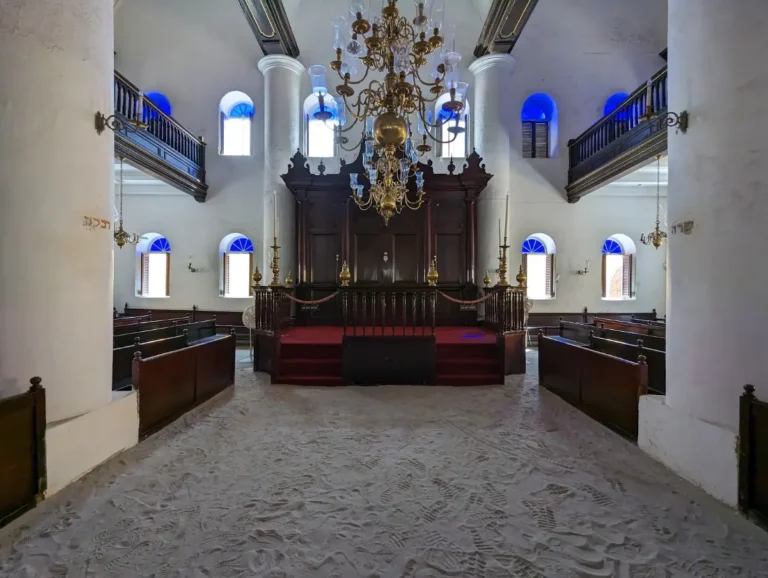
Many Jews left Suriname over the 19th and 20th centuries, and most of the rest emigrated, chiefly to the Netherlands, around independence in 1975. The Sephardi and Ashkenazi congregations merged in 1999, and since 2004 the remaining congregation, at Neve Shalom, has followed Progressive Judaism; it numbers about 130 people. The interior of Tzedek ve-Shalom, with its sand floor, was moved to the Israel Museum in Jerusalem, where it can be seen today.
Notable people
- Josef Nassy 1904–1976 · Paramaribo Painter of a Surinamese Jewish family, interned by the Germans in Belgium and Bavaria in 1942–1945; his 200 paintings and drawings record camp life.
Sources and further reading
- Aviva Ben-Ur and Rachel Frankel, Remnant Stones: The Jewish Cemeteries of Suriname (Hebrew Union College Press, 2009).
- Aviva Ben-Ur, Jewish Autonomy in a Slave Society: Suriname in the Atlantic World, 1651–1825 (University of Pennsylvania Press, 2020).
- “History of the Jews in Suriname”, Wikipedia.
Published October 2026.