
Tradition, prayer, and teshuvah for Yom Kippur
Yom Kippur, the Day of Atonement, is the holiest day of the Jewish year and the culmination of the Ten Days of Repentance that begin with Rosh Hashana. For Sephardic and Mizrahi Jews, it is a day of fasting, prayer, teshuvah, confession, reconciliation, and renewal.
“Sephardic” is often used as an umbrella term for the many distinct Jewish communities of the Mediterranean and Middle East—from Morocco and Algeria to Syria, Iraq, Egypt, Turkey, and Persia. Each developed its own melodies, piyyutim, and customs, and none should be assumed to speak for all the others.
This guide explores Sephardic Yom Kippur customs, prayers, fasting, teshuvah, Kol Nidre, the Avodah, Neilah, Kapparot, and other traditions, while highlighting differences between Sephardic and Ashkenazi practice where they are meaningful.
Yom Kippur is observed on the tenth day of the Hebrew month of Tishrei and is known in the Torah as Shabbat Shabbaton, a Sabbath of complete rest. It concludes the period of reflection and repentance that begins with Rosh Hashana.
The Hebrew word teshuvah is commonly translated as repentance, but its literal meaning is return. Yom Kippur therefore is not simply a day of fasting. It is an opportunity to acknowledge our mistakes, repair relationships, ask forgiveness, and return to the values we want to live by.
The day combines fasting, prayer, confession, charity, reflection, and communal worship.
Yom Kippur is not about suffering for its own sake. It is about creating space to confront who we have been—and who we can become.
The central idea of Yom Kippur is teshuvah—returning to the right path.
Teshuvah begins with recognizing what we have done wrong. But Jewish tradition does not stop with regret. Genuine repentance requires responsibility, an apology when someone has been harmed, an effort to repair the damage, and a commitment to change.
The Mishnah teaches that Yom Kippur does not atone for wrongdoing between one person and another until the person who was harmed has been appeased.
That makes reconciliation one of the most important preparations for Yom Kippur.
Before Yom Kippur begins, Jewish tradition emphasizes preparation of both body and soul. Give tzedakah, make peace with those you have hurt, ask forgiveness sincerely, and eat the traditional pre-fast meal.
The goal is not to enter Yom Kippur thinking only about how long you will go without food. Enter it thinking about what you want to change.
Sephardic communities begin reciting Selichot, penitential prayers, every day starting from Rosh Chodesh Elul—nearly a month before Yom Kippur. Ashkenazi practice typically begins only the week before Rosh Hashanah.
This extended season gives Sephardic and Mizrahi Jews more time to sit with teshuvah before the Days of Awe arrive, often gathering before dawn for communal prayer.
By the time Yom Kippur begins, the themes of repentance and return are already deeply familiar.
The Yom Kippur fast begins before sunset and continues until after nightfall the following evening.
Traditional Jewish law prohibits eating and drinking as well as four additional physical pleasures: washing for pleasure, anointing, wearing leather footwear, and marital intimacy.
The fast is intended to focus attention on the spiritual work of the day—not to endanger health.
Those whose health may be at risk should not attempt to fast against medical advice. Jewish law places the preservation of human life above the fast, and anyone with a medical condition should seek appropriate medical and rabbinic guidance.
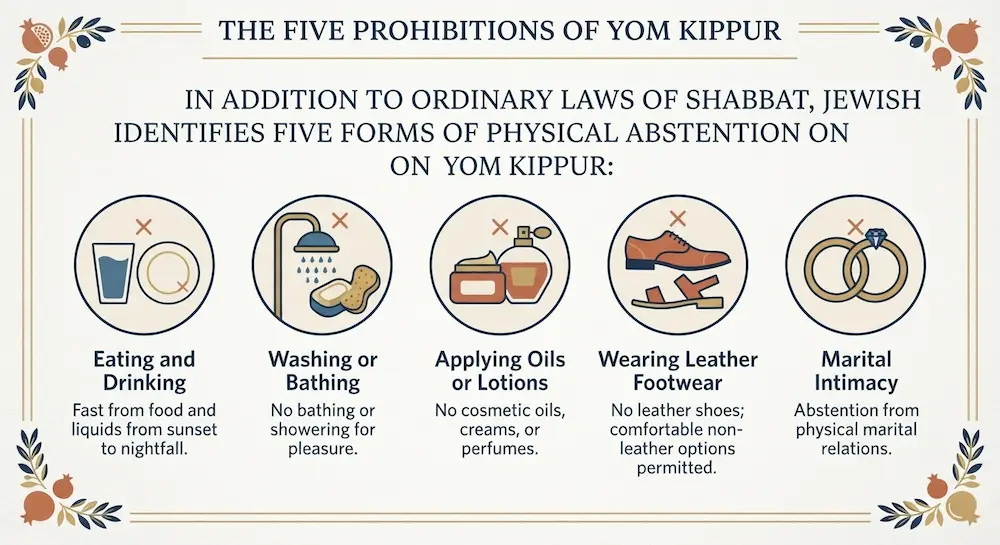
In addition to the ordinary laws of Shabbat, Jewish law identifies five forms of physical abstention on Yom Kippur:
These restrictions are not identical in their halakhic status. Eating and drinking have a distinct Torah basis, while the other restrictions have different rabbinic and biblical foundations.
The purpose is not self-punishment. Yom Kippur temporarily removes some ordinary physical comforts so that attention can turn toward prayer, reflection, repentance, and spiritual renewal.
| Tradition | Sephardic / Mizrahi | Ashkenazi |
|---|---|---|
| Prayer melodies | Regional melodies from North Africa, the Mediterranean and Middle East | Distinct Ashkenazi musical traditions |
| Piyyutim | Extensive Sephardic and regional repertoire | Distinct Ashkenazi repertoire |
| Avodah | Versions including Atah Konanta are prominent in many communities | Amitz Koach is prominent in many communities |
| Kapparot | Rabbi Yosef Karo opposed the chicken practice; charity is a Sephardic alternative | Chicken kapparot became widespread in many Ashkenazi communities |
| Birkat Kohanim | Recited at every service—Shacharit, Musaf, and Ne'ilah—in many communities | Typically recited once during the day in most Diaspora communities |
| Hebrew pronunciation | Sephardic pronunciation, with regional variations | Ashkenazi pronunciation, with regional variations |
| White clothing | Longstanding Sephardic and Mizrahi custom in many communities | Especially associated with the kittel in many communities |
| Melodies | Moroccan, Syrian, Iraqi, Turkish, Persian, Egyptian and other traditions | Eastern European and other Ashkenazi traditions |
Note: Neither column represents a single universal practice. Sephardic and Ashkenazi Judaism each contain numerous regional and communal traditions.
Yom Kippur begins with the haunting and familiar sound of Kol Nidre.
The ancient Aramaic declaration concerns vows and undertakings and has developed a complex legal and liturgical history. But for generations of Jews, its emotional significance has extended beyond the technical meaning of the words.
The opening of the ark, the Torah scrolls, the melody, and the gathering of the community create a powerful transition from ordinary time into Yom Kippur.
Sephardic and Mizrahi communities preserve distinctive Kol Nidre melodies that reflect the musical traditions of their ancestral communities.
Sephardic Yom Kippur prayer is filled with piyyutim, biblical passages, selichot, confessions, and poetic descriptions of the ancient Temple service.
These prayers preserve the voices of generations of Jewish poets and scholars, particularly those of the medieval Mediterranean world.
The melodies are just as important as the words. Moroccan, Syrian, Iraqi, Turkish, Persian, Egyptian, and other Sephardic communities each developed distinctive musical traditions.
For many families, these melodies are not simply synagogue music. They are an audible connection to parents, grandparents, and generations who prayed the same words before them.
Yom Kippur begins with the evening service and the haunting Kol Nidre declaration.
The morning service continues the prayers, confession, piyyutim, and Torah reading.
The additional service includes the dramatic Avodah recalling the Temple service.
The afternoon service includes the reading of the Book of Jonah and further prayers of repentance.
The closing service brings the community toward the end of Yom Kippur.
One of the most distinctive sections of Yom Kippur Mussaf is the Avodah, the poetic retelling of the service performed by the Kohen Gadol in the Temple.
Sephardic and Mizrahi communities preserved their own versions of this ancient liturgical tradition. One of the best-known is Atah Konanta Olam MeRosh, a piyyut that recounts the Yom Kippur Temple service in poetic form.
The Avodah connects the modern synagogue to the ancient Yom Kippur described in the Torah and the Talmud.
It is one of the places where Sephardic Yom Kippur becomes particularly rich in history, poetry, and memory.
Vidui, the confession of wrongdoing, is repeated throughout Yom Kippur in two forms: the brief Vidui Zuta (“Ashamnu”) and the longer, alphabetical Vidui Rabba (“Al Chet”), both recited communally at each service.
This structure gives us a framework for examining our behavior, but confession is not meant to become mechanical. Yom Kippur invites personal questions:
What did I do that hurt someone?
What relationship needs repair?
What do I need to change?
The most meaningful confession is one that leads to action.
Kapparot is a pre-Yom Kippur custom whose history is debated in Jewish law.
The practice of using a chicken developed in the medieval period. Rabbi Yosef Karo, the great Sephardic halakhic authority and author of the Shulhan Arukh, opposed the practice of slaughtering chickens as kapparot. Rabbi Moshe Isserles, representing the Ashkenazi tradition, defended the established custom.
For those following Rabbi Yosef Karo’s Sephardic ruling, giving money to charity is an appropriate alternative to chicken kapparot.
The deeper lesson is important: repentance cannot be transferred to an animal. Teshuvah requires the individual to recognize wrongdoing, seek forgiveness, make amends, and change.
White clothing is associated with Yom Kippur in many Jewish communities.
It can symbolize purity, humility, forgiveness, and the desire for spiritual renewal. It also recalls the white garments associated with the Kohen Gadol’s Yom Kippur service in the Temple.
The custom takes different forms among Sephardic, Mizrahi, and Ashkenazi communities. Some communities emphasize white clothing, while others have specific garments or local traditions.
The symbolism, however, remains powerful: Yom Kippur asks us not merely to appear different, but to become different.
After a full day of fasting and prayer comes Neilah, the final service of Yom Kippur. The word means “closing,” evoking the closing of the gates as the day ends.
Sephardic communities open Neilah with El Nora Alila, a piyyut by the Spanish poet Moshe ibn Ezra, sung to some of the year’s most stirring melodies.
In the final Amidah, the liturgy itself shifts: “Zochreinu” (remember us) becomes “Kotveinu” (inscribe us), reflecting the tradition that judgment is being sealed as the gates close.
Neilah is not simply a final request for forgiveness—it is the culmination of the day’s work: recognition, confession, reconciliation, and the commitment to live differently.
Yom Kippur traditionally concludes with a blast of the shofar.
After nearly a full day of fasting and prayer, the sound marks the transition from the holiness of Yom Kippur back into ordinary life.
But the message of the shofar extends beyond the moment itself.
The day ends.
Teshuvah does not.
The real measure of Yom Kippur is what we do after the fast: whether we repair relationships, change our behavior, strengthen our communities, and carry the lessons of the day into the year ahead.
Yom Kippur itself is a day of fasting, but food remains an important part of the holiday’s surrounding traditions.
The meal before the fast and the break-fast meal often preserve the culinary heritage of Sephardic and Mizrahi families.
Moroccan Jewish families may prepare traditional Moroccan dishes, while Syrian, Iraqi, Persian, Turkish, Egyptian, and other communities have their own distinctive customs.
These meals are more than recipes. They are another way Jewish families preserve the memory of where they came from.
Jewish tradition moves quickly from solemnity to joy.
Sukkot begins only a few days after Yom Kippur, and there is a longstanding custom of beginning preparations for the sukkah soon after the fast.
The symbolism is beautiful.
Yom Kippur turns us inward.
Sukkot turns us outward.
We reflect, repent, repair—and then return to life with gratitude, hospitality, and joy.
Yes. Sephardic and Ashkenazi Jews alike observe a full fast on Yom Kippur, abstaining from food and drink from before sunset until after nightfall the next day, in keeping with Torah law.
Jewish law identifies five forms of abstention: eating and drinking, washing or bathing for pleasure, applying oils or lotions, wearing leather footwear, and marital intimacy.
Kapparot is a pre-Yom Kippur atonement custom. While some communities use a chicken, Rabbi Yosef Karo, the leading Sephardic halakhic authority, opposed this practice and favored giving charity instead—a custom many Sephardic Jews still follow today.
Kol Nidre is the Aramaic declaration recited at the start of Yom Kippur addressing vows and oaths. Its haunting melody marks the emotional opening of the holiday for Jewish communities worldwide.
Ne’ilah is the closing service of Yom Kippur, held as the fast nears its end. It concludes with the blowing of the shofar, marking the close of the Day of Atonement.
Differences include distinct prayer melodies and piyyutim, when Selichot begins, versions of the Avodah service, views on Kapparot, and how often Birkat Kohanim (the Priestly Blessing) is recited during the day.
A concise guide to fasting, teshuvah, prayer, and meaningful Yom Kippur observance.
Continue exploring the Sephardic prayers of repentance that lead into the High Holy Days.
Find Sephardic congregations and communities around the world.
Yom Kippur gives us something rare: a day to stop.
To acknowledge what went wrong.
To ask forgiveness.
To forgive.
To repair.
And to begin again.
For Sephardic Jews, that experience is carried not only through words, but through melodies, piyutim, family traditions, and customs preserved across generations and continents.
The traditions may differ from Morocco to Syria, from Iraq to Turkey, from Egypt to Persia—but the invitation is the same.
Return. Reflect. Repair. Begin again.
G’mar Chatimah Tovah.