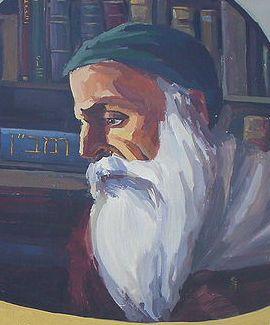
Philosopher who lost his only son in the 1391 riots and spent his last decades rebuilding Aragonese Jewry. His Or HaShem challenged Aristotle's physics, a critique later admired by Spinoza and by historians of science.
Who was Rabbi Hasdai Crescas?
Rabbi Hasdai ben Yehuda Crescas was a philosopher, rabbi and communal leader in fourteenth-century Aragon, and one of the most original Jewish thinkers of the Middle Ages. His book Or HaShem, “The Light of the Lord,” challenged the physics of Aristotle, which had ruled the learned world for centuries, and offered ideas about space, infinity and the will that later thinkers, Spinoza among them, would take up. He led the Jews of Aragon through the catastrophe of 1391, in which his only son was murdered.
Barcelona
Hasdai Crescas was born around 1340 in Barcelona, into a prominent family. He studied with the Ran, Rabbenu Nissim of Girona, and became one of the leaders of the community. He was close to the royal court of Aragon, where he served the Crown in various ways, and in 1367 he was among the Jewish leaders imprisoned for a time on a false accusation, together with his teacher the Ran. Around 1389 he moved to Zaragoza, where he became rabbi.
1391
In the summer of 1391, riots against the Jews spread from Seville across Castile and Aragon. Thousands were killed and many more were forced to convert. In Barcelona, the Jewish quarter was destroyed, and Crescas’s only son, a young man about to be married, was among the dead. In a letter to the community of Avignon, Crescas described the massacres city by city, a letter that remains one of the main sources for those events.
In the years that followed, he worked to rebuild the shattered communities of Aragon, with the support of the king, and to strengthen those who had remained Jews.
Or HaShem
Or HaShem, completed in 1410, was Crescas’s answer to the Jewish Aristotelian philosophy of his day, including that of the Rambam. With great rigor, he took apart the Aristotelian proofs about the universe: he argued that an actual infinite is possible, that empty space can exist, and that there could be other worlds besides our own. Ideas like these, startling in his time, have been compared to the views of later scientists and philosophers.
He also rethought the foundations of Jewish belief. Rather than the Rambam’s thirteen principles, he distinguished between the roots of all faith, the beliefs that the Torah itself depends on, and other true teachings. He held that the love of God, not intellectual knowledge alone, is the highest goal of human life.
Refuting the arguments for conversion
In the years after 1391, when many Jews were being pressed to convert, Crescas wrote a short work in Catalan refuting the principles of Christianity, to give those who wavered a reasoned answer. It survives in a Hebrew translation by Rabbi Yosef ibn Shem Tov, under the title Bittul Ikkarei HaNotzrim.
Death
Rabbi Hasdai Crescas died in Zaragoza around 1410 or 1411.
Rabbi Crescas’s legacy for Sephardim
Rabbi Hasdai Crescas faced the worst disaster in the history of Spanish Jewry with both courage and thought. As a leader, he rebuilt communities; as a philosopher, he defended the independence of Jewish faith from the authority of Aristotle. His student Rabbi Yosef Albo carried his ideas to a wide audience, and centuries later the Sephardic philosopher Spinoza cited him by name. He is a reminder that the Sephardic intellectual tradition was one of bold, independent thought.
Teachers and students
Sources
- Harry Austryn Wolfson, Crescas' Critique of Aristotle (Cambridge, MA: Harvard University Press, 1929)
- Warren Zev Harvey, Physics and Metaphysics in Hasdai Crescas (Amsterdam: J. C. Gieben, 1998)
- Hasdai Crescas, The Refutation of the Christian Principles, trans. Daniel J. Lasker (Albany: SUNY Press, 1992)