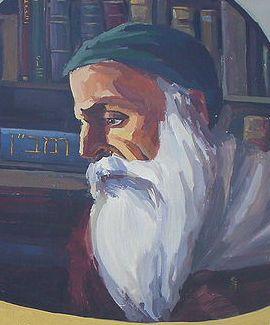
Leader of Catalan Jewry who defended Judaism before King James I at the Barcelona Disputation of 1263. Exiled after it, he reached Jerusalem in 1267 and refounded its Jewish community; the synagogue bearing his name still stands in the Old City.
Who was the Ramban?
Rabbi Moshe ben Nahman of Girona, known as the Ramban and in Latin as Nahmanides, was the leading sage of Catalan Jewry in the thirteenth century. His commentary on the Torah is one of the most studied ever written; his novellae on the Talmud reshaped how Talmud was learned in Spain; and his defense of Judaism before the King of Aragon at the Barcelona Disputation of 1263 is one of the great moments of courage in Jewish history. Exiled after it, he spent his last years in the Land of Israel, where the synagogue that bears his name still stands in Jerusalem’s Old City.
Girona
Moshe ben Nahman was born in Girona, in Catalonia, in 1194, to a distinguished rabbinic family. He earned his living as a physician, as many Sephardi sages did, and spent most of his life in Girona, which under his leadership became one of the great centers of Jewish learning in Europe. His teachers included Rabbi Yehuda ben Yakar, who had studied in northern France, and Rabbi Natan ben Meir of Trinquetaille in Provence. Through them the Ramban absorbed the sharp analytical method of the French schools and joined it to the Sephardi tradition of the Rif and the Rambam.
Girona was also home to a circle of early kabbalists, and the Ramban was its most authoritative figure. His standing gave the young Kabbalah a place inside mainstream Torah learning.
The Talmudist
The Ramban’s hiddushim, his novellae on the Talmud, brought the Tosafist way of learning into Spain and set the course for the Spanish schools that followed: his student Rabbi Shlomo ibn Aderet, the Rashba, and the Rashba’s students, the Ritva and the Ran. Generations of Sephardi and Ashkenazi students alike still learn Talmud with the Ramban open beside them.
He was also a great defender of earlier authorities. In Milhamot HaShem he defended the rulings of the Rif against the criticisms of Rabbi Zerahyah HaLevi, and in his glosses on the Rambam’s Sefer HaMitzvot he respectfully challenged the Rambam’s count of the commandments while defending the work of the Geonim. His Torat HaAdam on the laws of mourning and illness is still a standard reference.
When the controversy over the Rambam’s philosophical writings broke out in the early 1230s, the Ramban tried to calm it. He wrote to the rabbis of France urging them not to ban the Rambam’s works, even as he took a more traditional position on some of the questions the Rambam had raised.
The commentary on the Torah
The Ramban’s commentary on the Five Books of Moses is the work by which most Jews know him. It is written in a warm, flowing Hebrew and combines the plain meaning of the text, the teachings of the Midrash, and careful psychological insight into the people of the Torah. He often disagrees with Rashi and with Avraham ibn Ezra, and his debates with them are studied as closely as his own conclusions.
He also opens hints to deeper meanings, introducing them with the words al derekh ha-emet, “by the way of truth,” the way of Kabbalah. He discusses the story of the patriarchs as a sign of what would happen to their descendants, and he treats the commandment to settle the Land of Israel as binding in every generation, a position that would become central to later Jewish thought.
The Barcelona Disputation
In July 1263 King James I of Aragon summoned the Ramban to a public disputation in Barcelona. His opponent was Pablo Christiani, a Jewish convert who had become a Dominican friar. The Dominicans hoped to prove from the Talmud and Midrash that the Messiah had already come and that the rabbis themselves knew Jesus to be divine.
The Ramban agreed on one condition: the freedom to speak openly. Over several sessions he argued that the passages Christiani cited proved nothing of the kind, that the aggadot of the Midrash were not binding doctrine, and that the world, still full of war and oppression, showed no sign of the messianic age the prophets described. The king is reported to have praised him and given him a gift.
At the request of the Bishop of Girona, the Ramban wrote down his account of the debate. The Dominicans charged him with blasphemy for it. The king tried to protect him, but under pressure from the Church the Ramban, by then about seventy, left his home and his family and set out for the Land of Israel.
Jerusalem and Acre
He reached the Land of Israel in 1267 and went up to Jerusalem, still devastated by the Mongol raid of 1260. In a letter to his son he wrote of the ruin he found and of a community so small it barely made a minyan. He brought a Torah scroll back from Shechem, where it had been taken for safety, and established a synagogue in a ruined house. The Ramban Synagogue in Jerusalem’s Old City preserves his name to this day.
He then moved to Acre, where he taught and completed his commentary on the Torah. He died around 1270. Where he was buried is uncertain: traditions point to Acre, to Haifa near the grave of Rabbi Yehiel of Paris, and to Hebron.
The Ramban’s legacy for Sephardim
The Ramban stands at the center of the Sephardic Talmudic tradition. The Rashba, the Ritva and the Ran built on his work; Maran Yosef Karo cites him constantly; and Sephardi yeshivot from Jerusalem to Casablanca have always taught Talmud with his novellae. His commentary on the Torah is read every week in Sephardi homes and synagogues, and his insistence on the commandment to live in the Land of Israel still shapes how Jews understand the bond between the people and the Land.
A letter traditionally attributed to him, the Iggeret HaRamban, written to his son on humility and the fear of Heaven, is read in many communities on Shabbat. Whether or not he wrote every word, it captures what generations have loved in him: a giant of learning who never forgot that learning must make a person kinder and more humble.

Teachers and students
Sources
- Robert Chazan, Barcelona and Beyond: The Disputation of 1263 and Its Aftermath (Berkeley: University of California Press, 1992)
- Nina Caputo, Nahmanides in Medieval Catalonia: History, Community, and Messianism (Notre Dame: University of Notre Dame Press, 2007)
- Moshe Halbertal, Al Derekh HaEmet: HaRamban VeYetziratah shel Masoret (Jerusalem: Shalom Hartman Institute, 2006)
- Nahmanides, Commentary on the Torah, trans. Charles B. Chavel (New York: Shilo, 1971–1976)