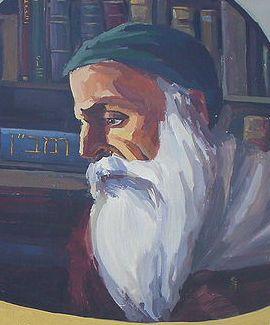
Leading sage of fourteenth-century Barcelona, best known for his commentary on the Rif, printed alongside the Talmud. His teachers' line ran back to the Rashba, and his students included the Rivash and Hasdai Crescas.
Who was the Ran?
Rabbenu Nissim ben Reuven of Girona, known by the acronym the Ran, was the leading Talmudic authority of fourteenth-century Catalonia. His commentary on the Rif’s Halakhot is printed in every edition of the Talmud, his commentary on tractate Nedarim stands on the page of the Talmud itself, and his sermons, the Derashot HaRan, are a classic of Jewish thought. His students included the Rivash and Rabbi Hasdai Crescas, the great sages of the next generation.
Barcelona
Nissim ben Reuven was born around 1320, and his family name links him to Girona, the Catalan city of the Ramban. He spent his life in Barcelona, where he served as rabbi and head of the yeshiva, and where questions came to him from across Spain and from as far as North Africa and the Land of Israel. He is said to have practiced medicine as well.
His time was a troubled one. The Black Death reached Barcelona in 1348, followed by attacks on the Jews, and in the 1360s and 1370s the community faced growing pressure from the Crown and the Church. At one point the Ran and other leaders of the community were imprisoned for some months on a false accusation.
His commentaries
The Ran’s best-known work is his commentary on the Rif. He explains the Rif’s rulings in the light of the Talmud and of the great Spanish sages, the Ramban and the Rashba above all, and adds his own conclusions. Students of the tractates of Shabbat, Pesahim, Ketubbot and others know it as one of the essential tools for understanding the law.
His commentary on tractate Nedarim, on vows, became so central that it is printed on the inner column of the Talmud’s page, where Rashi’s commentary normally stands. He also wrote novellae on many tractates, and about a hundred of his responsa survive.
The Derashot HaRan
The Derashot HaRan are twelve sermons on the foundations of faith: prophecy, the giving of the Torah, the authority of the sages, the purpose of the commandments, and the relationship between the law of the Torah and the law of kings. In one famous sermon, he explains that the Torah’s courts were meant to judge by the strict law of truth, while a separate royal justice was needed to keep order in society. The Derashot were studied by Sephardi thinkers for centuries and are still read today.
Death
The Ran died in Barcelona around 1376. The date of his death is not known with certainty, and no hilula date is widely recorded.
The Ran’s legacy for Sephardim
The Ran was the teacher of the last great generation of Spanish Torah before the catastrophe of 1391. His student the Rivash carried his teaching to North Africa, where it shaped the Torah of Algeria and the whole Maghreb, and his student Hasdai Crescas became the great philosopher of the age. Every student who opens a tractate of the Talmud with the Ran’s commentary beside it is learning in the school of Barcelona.

Teachers and students
Sources
- "Nissim ben Reuben Gerondi," Encyclopaedia Judaica, 2nd ed. (2007)
- Derashot HaRan, ed. Leon A. Feldman (Jerusalem: Shalem Institute, 1973)